
Quick take
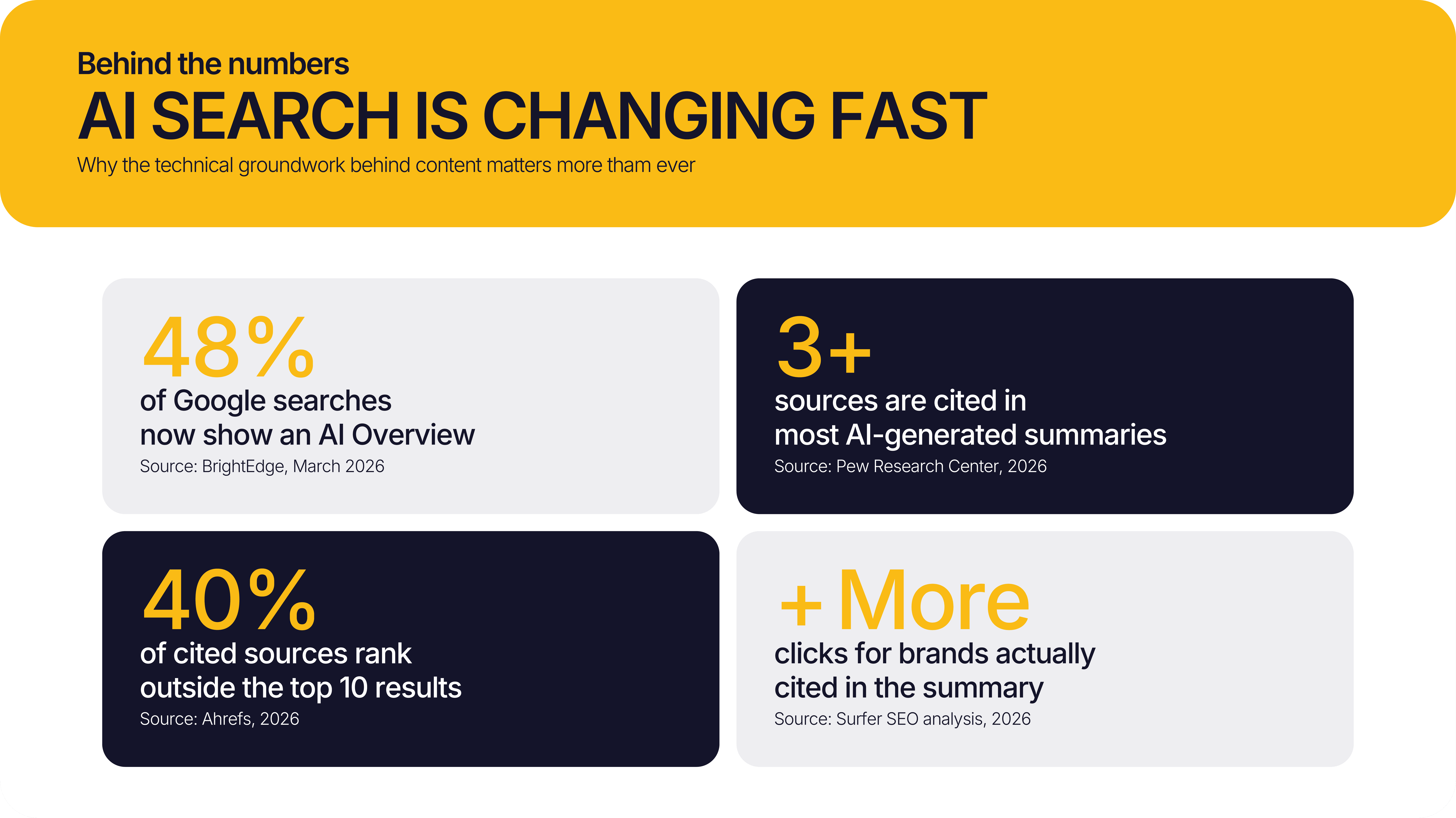
48% of Google searches now show an AI Overview (source: BrightEdge, March 2026).
3+ sources are cited in most AI-generated summaries (source: Pew Research Center, 2026).
40% of cited sources rank outside the top 10 results (source: Ahrefs, 2026).
More clicks for brands actually cited in the summary (source: Surfer SEO analysis, 2026).
None of that happens by accident. It comes from content structure, internal linking, and technical groundwork, the part of SEO that never makes it into a portfolio screenshot.
People come to us for branding and beautiful websites. Fewer people know that some of our most demanding work happens after the website goes live, in the words that fill it, and in the technical scaffolding holding those words together.
Take one of our long-term clients, a wealth advisory group serving high-net-worth families across multiple jurisdictions. Their world is family offices, trust structures, residency programmes, and cross-border tax planning. None of it is simple, and almost none of it forgives a sloppy explanation. It is also a useful case study in why “just write good content” is never the whole answer.
The brief is never just “write an article”
Every piece starts with a topic the client's own team has flagged from real client conversations:
What a family office actually does, and how it differs from a regular wealth manager
How wealth structuring works across different legal jurisdictions
What a new tax exemption in a country like Turkey might mean for someone considering residency there
How bookkeeping and accounting services should be positioned for an international client base
These are not trending topics with existing templates to follow. They require understanding a niche well enough to explain it clearly, without drifting into jargon or oversimplifying a subject where the details matter. Get a residency rule or a tax threshold wrong, and it isn't just an SEO problem, it's a credibility problem for a client whose entire business rests on being trusted with people's money.
Our process is close and iterative:
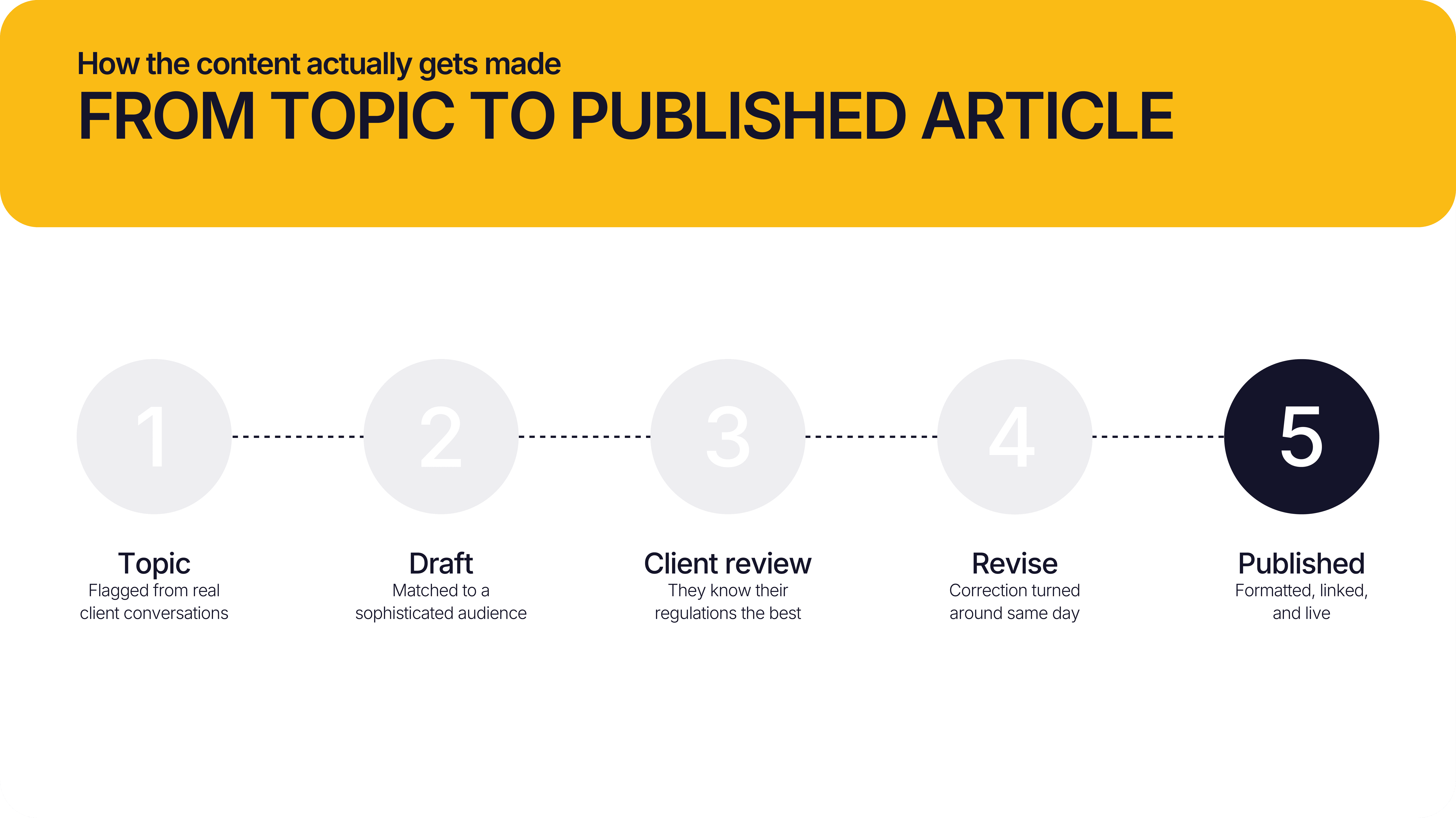
One article came back with a note: wrong information and photo in the last version, please scrap it and use this instead. We did, and the corrected version went live within a day. Precision matters more than speed here, but it turns out you can have both.
Then the harder question: why isn't it ranking?
After months of publishing solid, well-researched content, the client raised a fair concern: rankings weren't moving the way they should for the volume of content going up. It would have been easy to reach for “more articles” as the fix. Instead, we went back to basics and ran a full technical audit. That is where the real work started.

The technical side, in more detail
This is the part nobody screenshots, but it's usually where rankings are actually won or lost.
Internal linking and site architecture
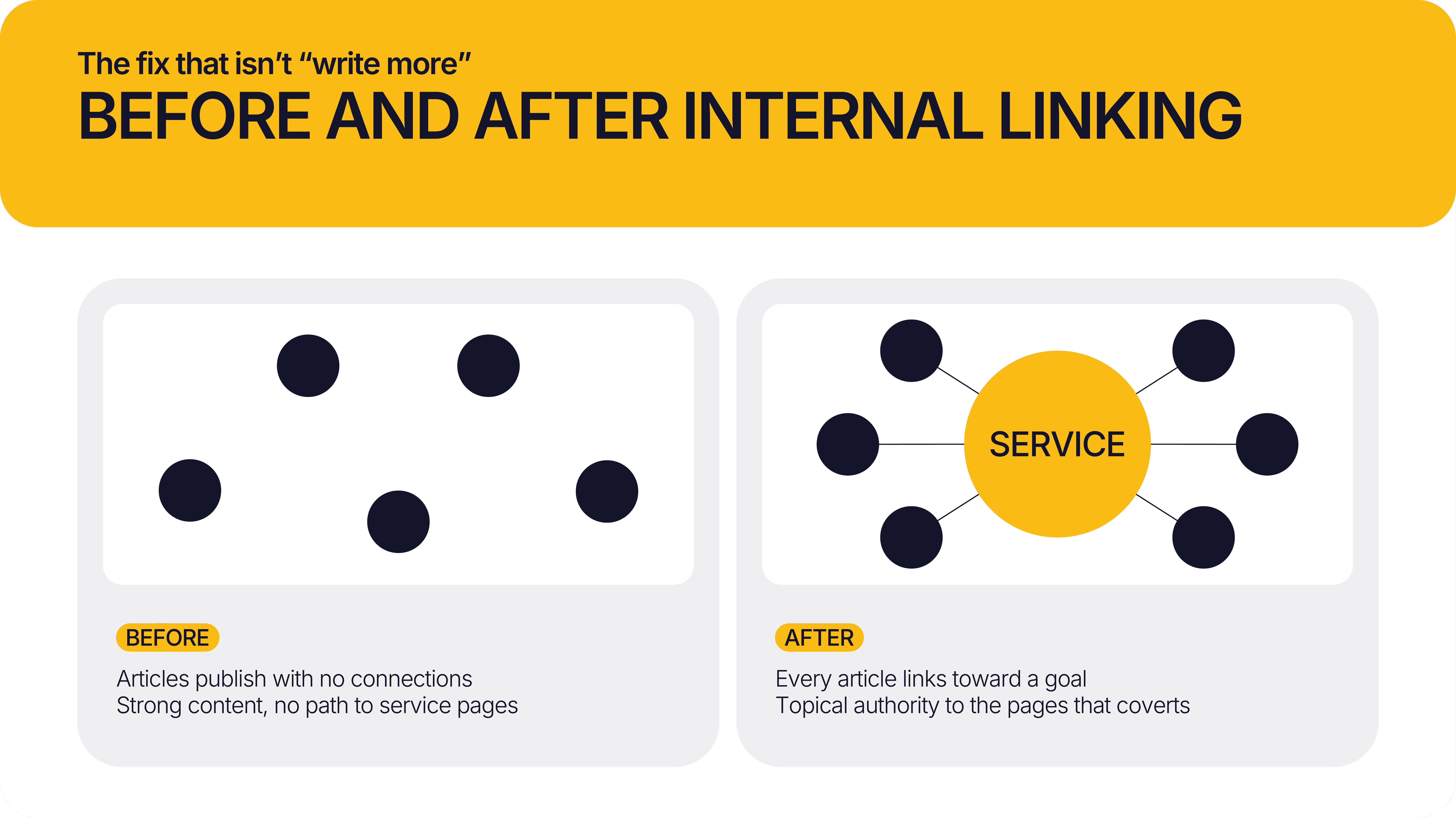
A site can have forty well-written articles and still underperform if none of them link to each other or to the service pages that actually generate business. We mapped every article against the service pages it should support, then rebuilt the internal linking so that topical authority flows toward the pages that matter commercially, not just toward the homepage. Anchor text matters here too: generic “click here” links carry far less weight than descriptive, keyword-relevant phrasing.
Topic clusters instead of scattered articles
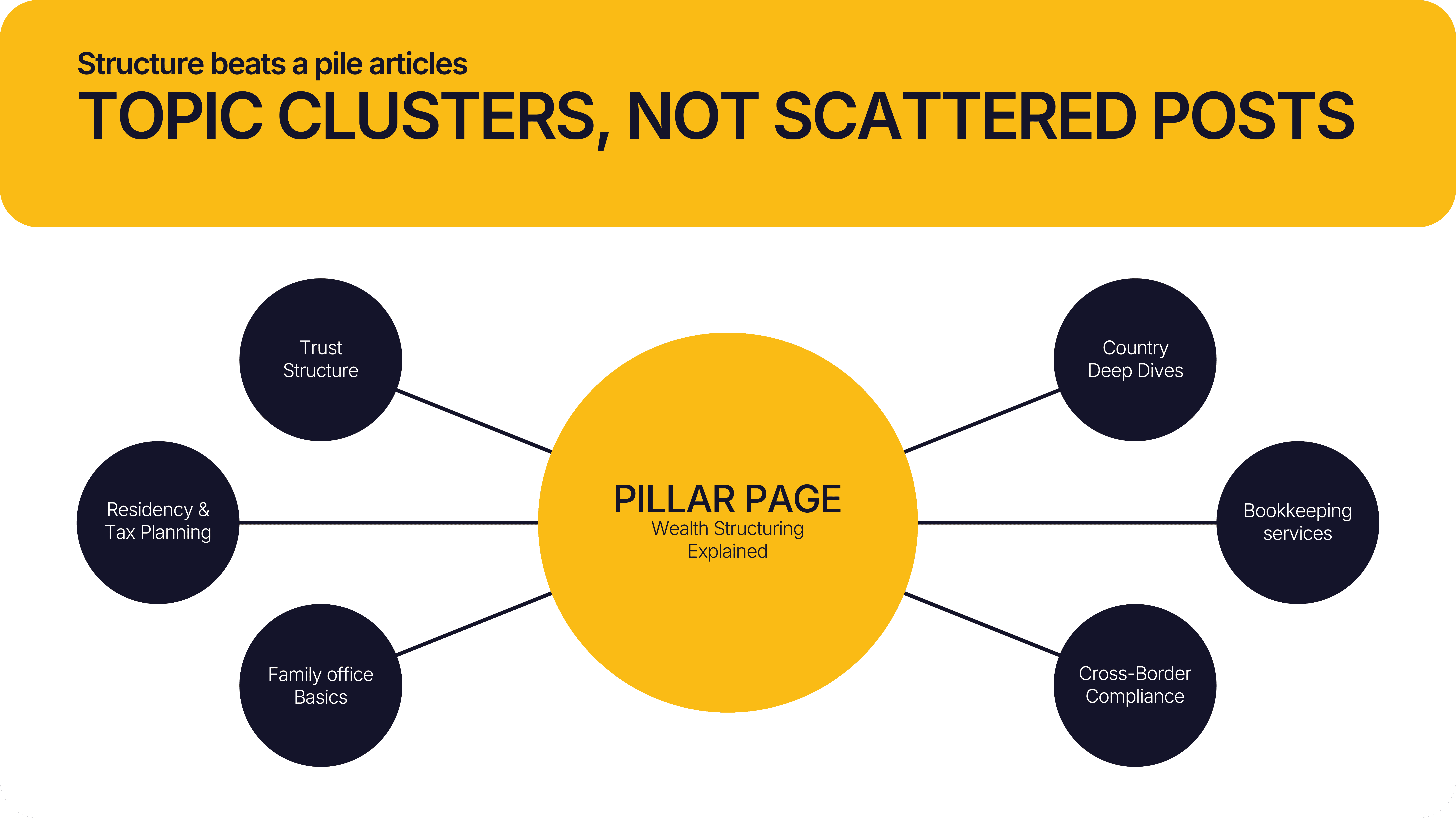
Rather than treating each article as a standalone piece, we grouped them into clusters around pillar topics (family office structures, residency and tax planning, wealth structuring), with a central pillar page and supporting articles linking back into it. Search engines reward this kind of topical depth far more than a pile of unconnected posts, even if the total word count is identical.
Crawl efficiency
For a site adding new pages regularly, we checked how efficiently Google was actually finding and re-crawling them:
Sitemap accuracy, making sure every published page is actually listed
Orphaned pages with no internal links pointing to them
Redirect chains left over from earlier site changes, which quietly waste crawl budget
An article can be excellent and still sit invisible if nothing points a crawler toward it.
E-E-A-T for a sensitive, high-stakes niche
Finance and tax content falls into what Google treats as “Your Money or Your Life” territory, held to a higher bar for trust and expertise signals than, say, a recipe blog. That means author credentials, clear sourcing, up-to-date figures, and a genuine point of view from people who actually work in the field, not just competent generalist writing. We built this into the brief from the start rather than bolting it on afterward.

Schema markup and technical hygiene
Structured data (Article schema, FAQ schema where relevant, breadcrumb markup) helps search engines understand what a page is and how it fits into the site, and increasingly feeds how AI-driven search summaries decide what to cite. We audited and cleaned this up alongside the content work.
Preparing for AI Overviews and LLM-driven search
This is newer territory for everyone, and the numbers explain why it can't be ignored:
AI Overviews now appear on roughly half of Google's search results, up sharply year over year (source: BrightEdge, 2026)
Around 88% of AI-generated summaries cite three or more sources rather than just one, meaning there's real room to be one of the sources cited (source: Pew Research Center, 2026)
Roughly 40% of the pages cited inside AI Overviews aren't in the traditional top 10, they rank further down the page but still get pulled into the summary (source: Ahrefs, 2026)
Content written to answer a specific question clearly and early, backed by structured data and strong internal context, has a real shot at being quoted directly inside an AI answer, in Google itself or in tools like ChatGPT and Perplexity
We shaped newer articles with this in mind: a clear, direct answer up top, supporting detail after, so the piece works whether a human reads it or an AI system is summarizing it for someone else.
What this work actually requires
Research literacy in a specialist field (finance, tax, and legal structuring) without a finance or legal degree in the room
Honest reporting back to a client, including when the news is “your content is fine, the plumbing isn't”
Technical SEO thinking: site architecture, internal linking, crawl efficiency, and schema, not just keywords
An eye on how content needs to perform in AI-driven search, not only traditional rankings
Fast turnaround without cutting corners, including same-day corrections when a client catches an error before publishing
Comfort saying no to the easy answer (“just publish more”) when the data points somewhere less obvious
Why this matters beyond one client
Branding gets the spotlight. But a brand identity means little if the content built on top of it cannot be found, trusted, or acted on. Writing for a family office audience is a world away from writing hospitality copy or packaging taglines, and switching fluently between them, while also handling the technical groundwork underneath, is part of what a full-service agency is supposed to do.
The visual work is what people notice first. The content strategy and technical SEO underneath it are what keep a site actually working, and actually found, months and years later. In a search landscape where being quoted by an AI summary matters as much as ranking first, that groundwork is only getting more important, not less.


เรามาติดต่อกันเถอะ
ติดตาม Asia Media Studio เพื่อรับข้อมูลเชิงลึกเกี่ยวกับการออกแบบและการอัปเดตบน Facebook, Instagram และ LinkedIn.