
Why Google Ads matters for businesses in Bangkok
Thailand has over 61 million internet users, and search engines remain the number-one channel for brand discovery — ahead of social media. In Bangkok alone, millions of searches happen every day for services like restaurants, clinics, co-working spaces, and professional services. Google Ads lets you show up at the exact moment someone is looking for what you offer. Unlike organic SEO, which takes months to build, paid search can deliver results within days of launching a campaign.
How Google Ads works: the basics
Google Ads operates on an auction system. When someone types a search query, Google runs a lightning-fast auction to decide which ads appear and in what order. Your position depends on two things: how much you bid and how relevant your ad is (known as Quality Score). A higher Quality Score means you can pay less per click and still outrank competitors.
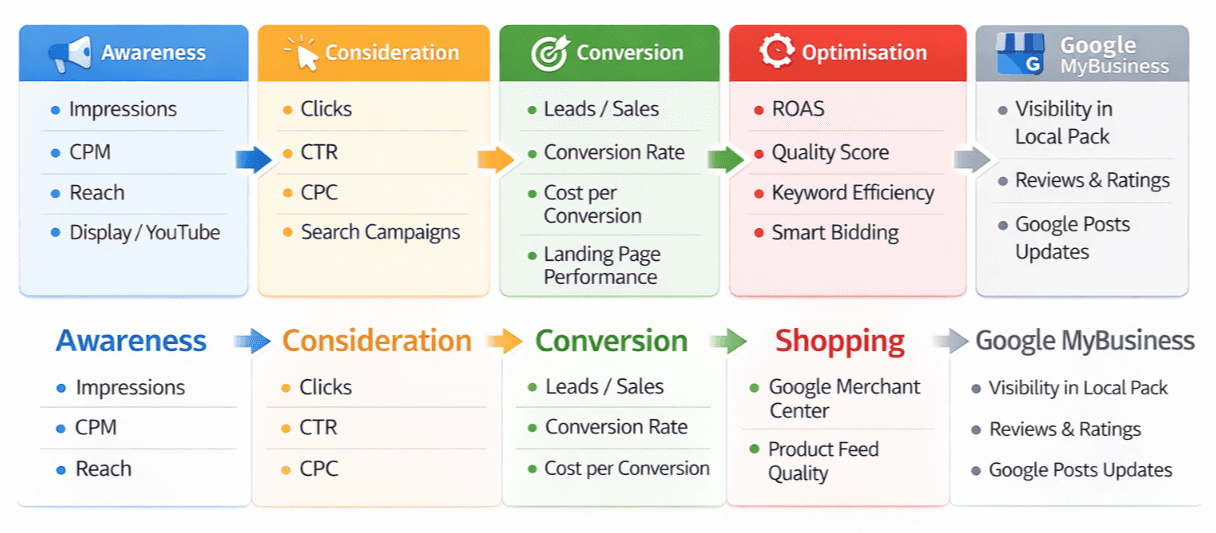
Key concepts to understand:
CPC (cost per click): You only pay when someone actually clicks your ad, not when it appears.
Keywords: The search terms you target. Choosing the right ones is critical — too broad wastes budget, too narrow limits reach.
Quality Score: Google rates your ad relevance, landing page experience, and expected click-through rate on a scale of 1–10.
Ad Rank: Your bid multiplied by your Quality Score determines where your ad appears.
Campaign types: which one should you use?
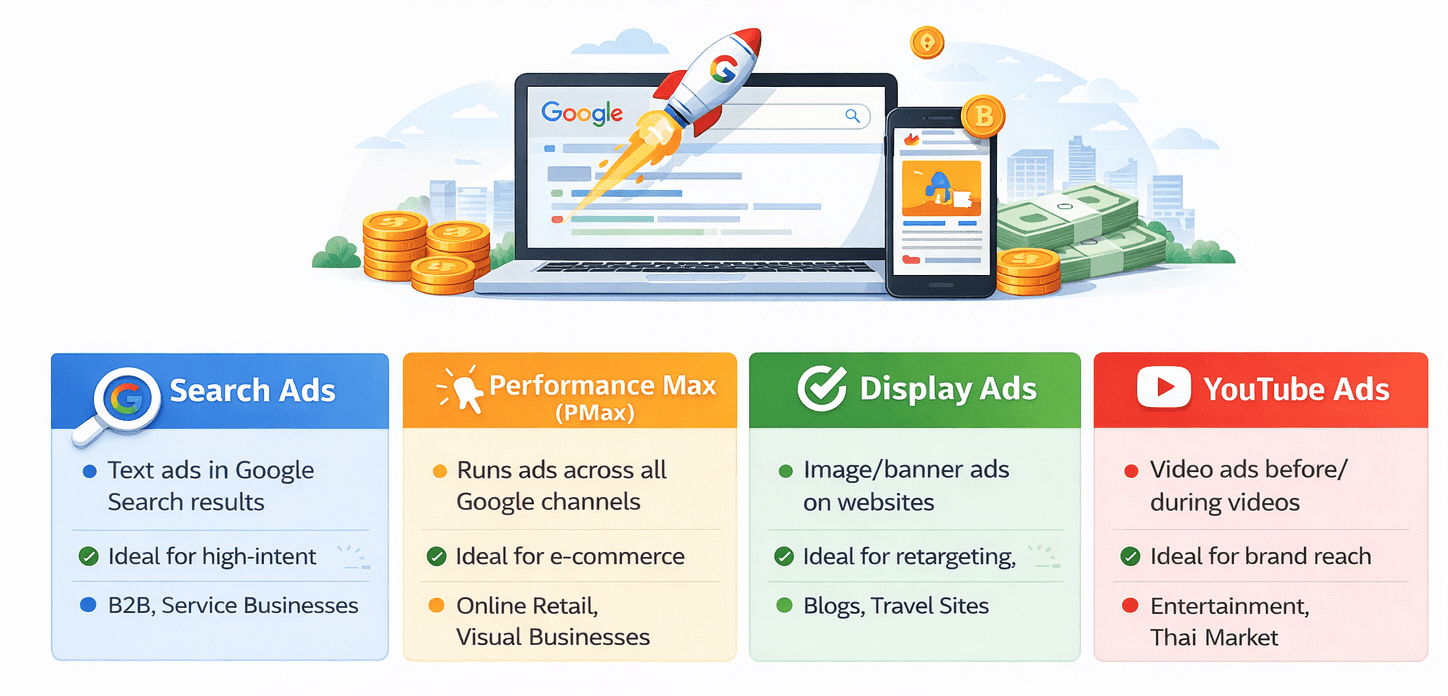
Google offers several campaign types, but not all are suited for every business. Here are the most relevant ones for Bangkok-based companies:
Search campaigns
The most straightforward type. Your text ads appear when people search for specific keywords. Ideal for service businesses, B2B companies, and anyone targeting high-intent queries like “best co-working space in Bangkok” or “web design agency Thailand.”
Performance Max (PMax)
Google’s AI-driven campaign type that runs ads across Search, Display, YouTube, Gmail, Maps, and Discover — all from a single campaign. In 2026, PMax has matured significantly with better controls for excluding brand terms and setting search themes. It works well for e-commerce and businesses with strong visual assets, though it requires careful setup to avoid wasting budget on low-quality traffic.
Display campaigns
Banner ads that appear across Google’s network of partner websites. Great for brand awareness and retargeting (showing ads to people who visited your site but didn’t convert). Less effective for direct lead generation compared to Search.
YouTube video ads
Video advertising has become central to Google’s ecosystem. With short-form video dominating consumer attention in Thailand, YouTube ads — including Shorts — are an increasingly powerful way to build awareness and drive action. You can target by demographics, interests, or even specific channels your audience watches.
Budgeting: what to expect in Thailand
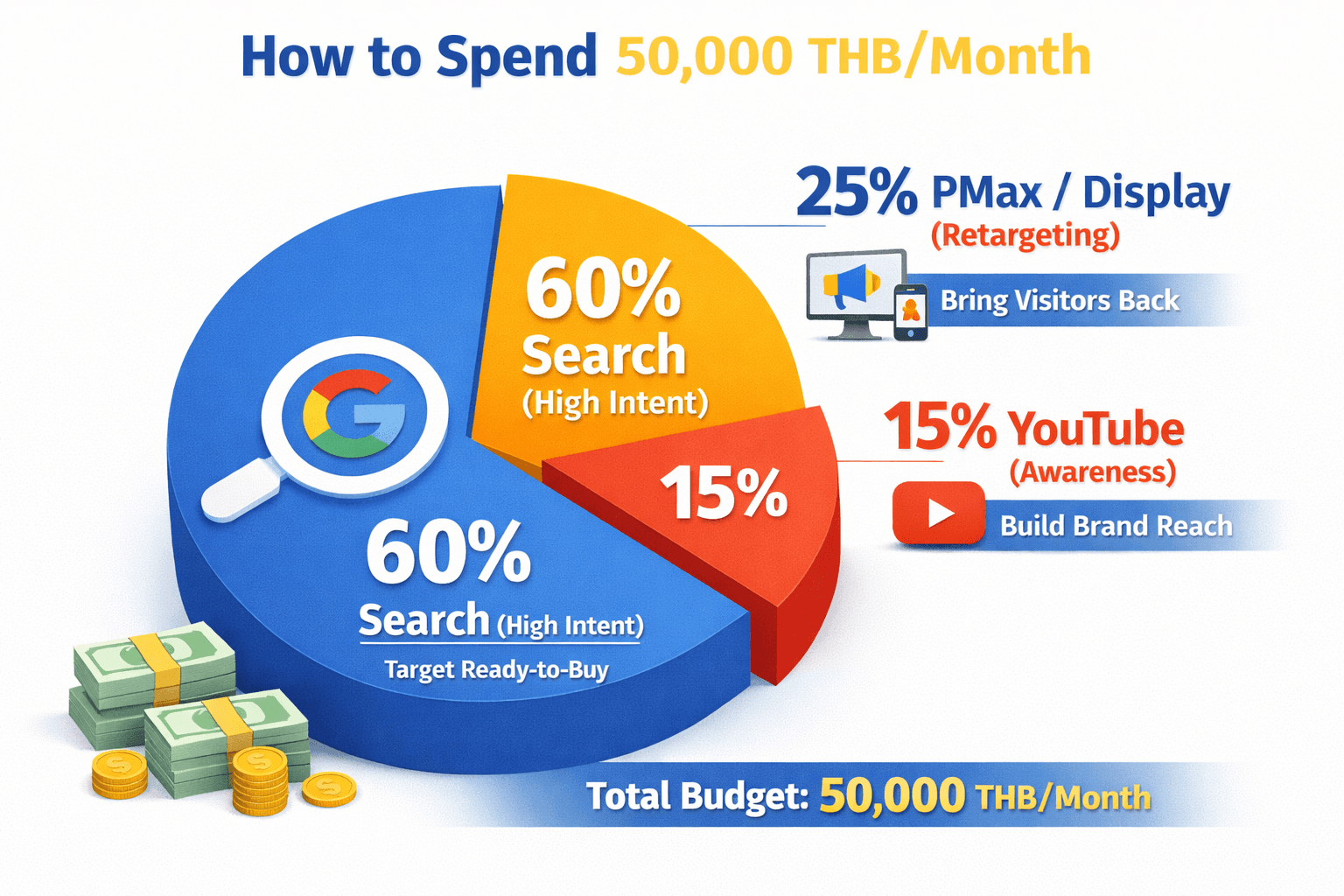
One of the most common questions we hear is “How much should I spend?” The honest answer is: it depends on your industry, competition, and goals. However, here are some practical guidelines for the Thai market:
Factor | Guideline |
|---|---|
Minimum monthly budget | 15,000–30,000 THB for testing; 50,000+ THB for sustained campaigns |
Average CPC (Search) | 5–40 THB depending on industry; legal and finance tend higher |
Average CPC (Display) | 1–5 THB, useful for awareness and retargeting |
Recommended test period | At least 30–60 days before judging results |
Agency management fee | Typically 15–20% of ad spend or a fixed monthly retainer |
The key is to start with a focused budget on high-intent keywords, measure results carefully, and scale what works. Avoid spreading a small budget across too many campaigns at once.
What’s new in Google Ads for 2026
The platform is evolving rapidly. Here are the most important changes businesses should be aware of this year:
AI Max campaigns: Google’s next evolution of automation, combining audience targeting, bidding, and creative optimisation into a single AI-driven system. It’s being pushed as the default for Search campaigns, but hybrid approaches that combine AI Max with manual controls are proving more effective.
AI Overviews in search: Google now shows AI-generated summaries at the top of search results, which may reduce clicks on traditional ads. Analysts suggest that up to 60% of searches could become zero-click. This makes ad quality and landing page relevance more important than ever.
Smarter bidding tools: New simulation features let you preview how different bidding strategies might perform before committing, reducing risk when testing new approaches.
Video-first advertising: Video ads across YouTube, Shorts, and Connected TV are now central to Google’s ecosystem. Brands that invest in short-form video creative will have a significant advantage.
Better Performance Max controls: Advertisers can now control search terms, exclude brand traffic, and get clearer reporting on what’s actually working within PMax campaigns.
Common mistakes to avoid
After managing Google Ads campaigns for clients across industries, we’ve seen certain mistakes come up again and again:
Targeting too broadly — casting a wide net burns budget fast. Start narrow with high-intent keywords and expand from there.
Ignoring negative keywords — without exclusions, your ads show for irrelevant searches. Regularly review your search terms report and add negatives.
Sending traffic to your homepage — create dedicated landing pages that match the ad’s promise. A generic homepage kills conversion rates.
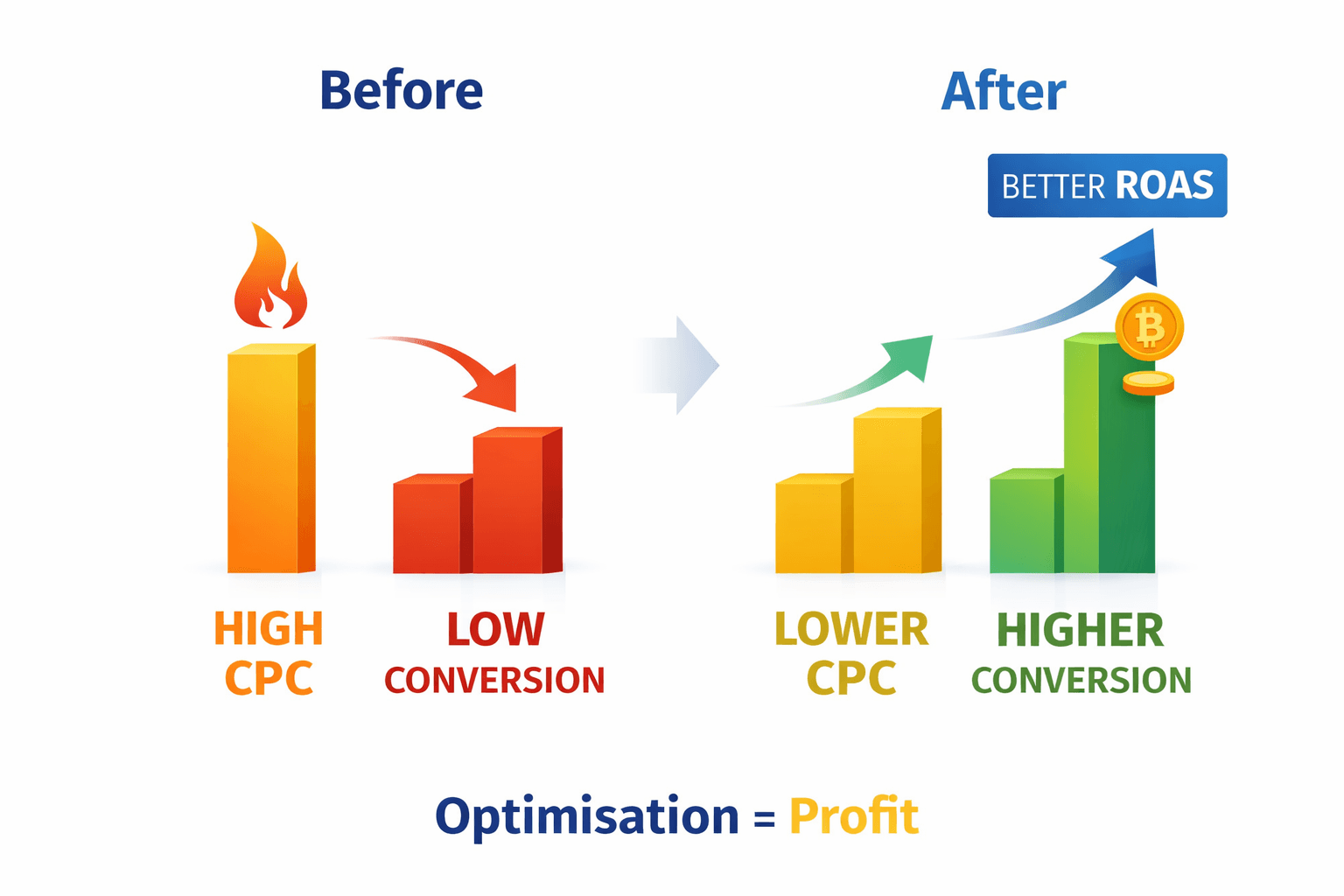
Conversion tracking is no longer optional — it’s the foundation of any successful Google Ads campaign. Today’s platform is heavily driven by machine learning, meaning Google’s algorithms rely entirely on your data to make decisions. Without accurate tracking, the system is essentially operating blind: it may optimise for clicks or traffic instead of actual business results like leads or sales.
Modern features such as Smart Bidding, Performance Max, and AI Max campaigns don’t just use your inputs — they actively learn from conversion signals to improve over time. If those signals are missing, incomplete, or incorrect, the algorithm will optimise toward the wrong outcomes, often leading to wasted budget and poor-quality traffic. In other words, bad data doesn’t just limit performance — it actively harms it.Expecting overnight results — Google’s Smart Bidding needs 2–4 weeks of data to stabilise. Give your campaigns time before making major changes.
Blindly following Google’s recommendations — Google’s in-platform suggestions often prioritise spending more. Evaluate each recommendation critically against your actual business goals.
Should you manage it yourself or hire an agency?
For businesses with simple needs and small budgets (under 30,000 THB/month), self-management with Google’s built-in tools can work — especially if you invest time in learning the platform. Google’s own courses and certifications are free.
However, as budgets grow and campaigns become more complex, working with an experienced agency typically delivers better ROI. A good agency brings strategic thinking, technical expertise, and continuous optimisation that’s hard to replicate in-house unless you have a dedicated specialist.
When evaluating agencies, look for transparent reporting, clear communication, and a track record with businesses similar to yours. Be cautious of agencies that promise guaranteed rankings or results — Google Ads performance depends on many factors, and honesty about what’s achievable matters more than bold promises.
Getting started: a simple checklist
Ready to launch your first campaign? Here’s a step-by-step starting point:
Define your goal clearly (leads, sales, calls, or website visits)
Set up conversion tracking before spending anything
Research 10–20 high-intent keywords relevant to your service
Write compelling ad copy that matches what people are searching for
Build a focused landing page with a clear call to action
Set a daily budget you’re comfortable testing with for 30 days
Launch, monitor weekly, and optimise based on data — not gut feeling
Need help getting started with Google Ads?
At Asia Media Studio, we’ve been helping Bangkok businesses grow through digital marketing since 2007. Whether you need a full campaign setup, ongoing management, or a one-time audit of your existing ads, our team is here to help.


Let’s keep in touch.
Follow Asia Media Studio for design insights and updates on Facebook, Instagram, and LinkedIn.