
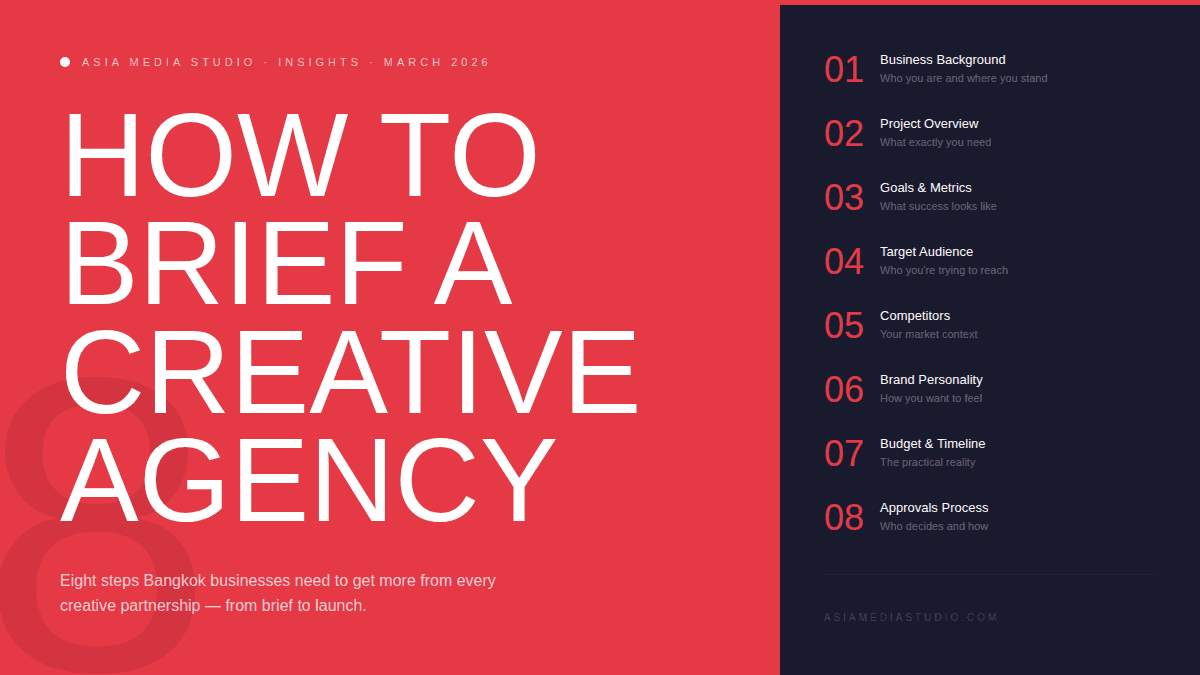
What Is a Creative Brief — and Why Does It Matter?
A creative brief is a short document that gives the agency everything they need to understand your business, your goals, and your expectations before any work begins. Think of it as a contract of understanding — not legal, but strategic.
Without a brief, the agency is essentially guessing. With a great brief, the first round of creative concepts will be dramatically closer to what you actually need.
From 18 years of experience at AMS:
The quality of a brief is directly proportional to the quality of the first creative concept. Clients who invest 30 minutes in a thorough brief save weeks of revision cycles.
In Bangkok's competitive business landscape — where speed-to-market matters and agency rates are premium — a poor brief is an expensive mistake.
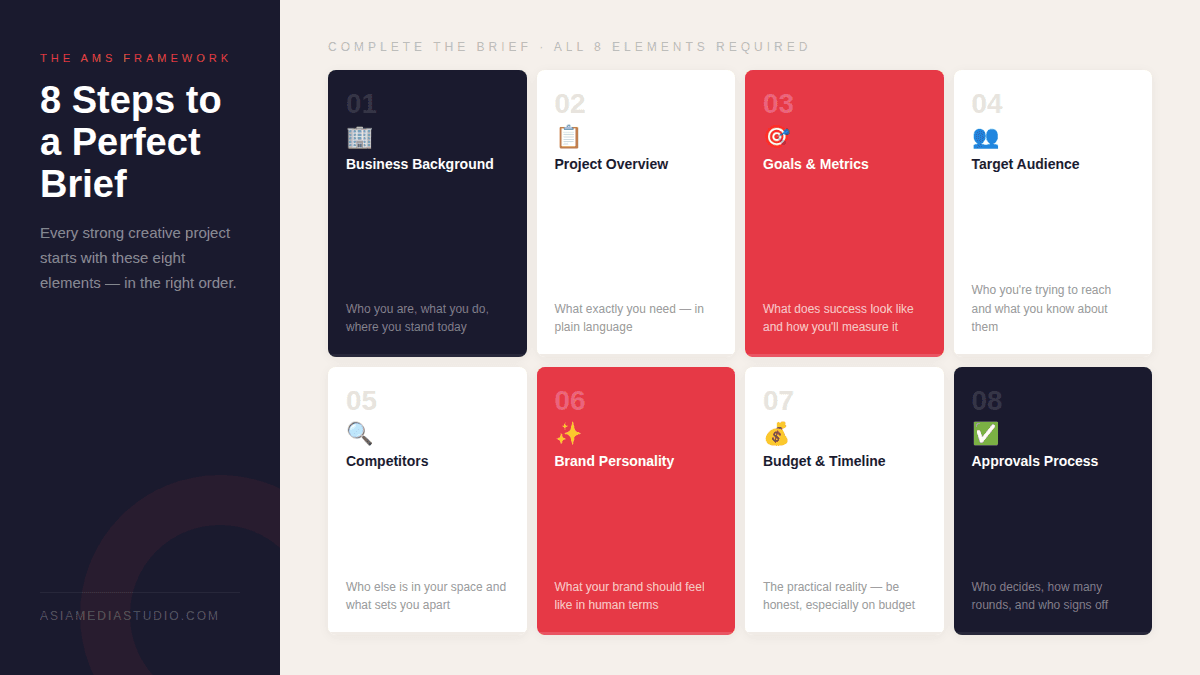
The 8 Elements of a Strong Creative Brief
Not all briefs need to be long. But they do need to cover the right ground. Here are the eight elements that every brief for a branding, web, or digital project should include.
Step 1: Business & Brand Background
Who you are, what you do, and where you stand today.
The agency needs to understand your business before they can help you grow it. Give them the context they need:
What your company does and who it serves
How long you've been operating and in which markets
Your current brand positioning (premium, affordable, specialist, etc.)
Any brand guidelines or existing assets that must be respected
Bangkok tip: If you serve both Thai and international audiences, flag this early. It affects language, visual style, and messaging tone significantly.
Related AMS service |
Step 2: Project Overview
What exactly do you need, in plain language.
Describe the project at a high level. Avoid jargon — clarity beats sophistication here.
Is this a new brand identity, a website redesign, a campaign, or all three?
Is it a full build from scratch, or an evolution of something that already exists?
What is the primary output? (Logo files, live website, ad creatives, social templates, etc.)
AMS insight: Clients sometimes say they need a 'rebrand' when they actually need a 'brand refresh.' These are very different scopes. Be specific about what you want to change — and what you want to keep.
Step 3: Goals & Success Metrics
What does success look like — and how will you measure it?
Vague goals produce vague creative. Tell the agency what you're trying to achieve:
Increase website enquiries by 30% within 6 months
Reposition the brand to attract a premium clientele
Launch in the Thai market by Q3 with strong local relevance
Improve brand recognition among expat communities in Bangkok
If your goals are measurable, the agency can design to support them. If they're not, creative decisions become guesswork.
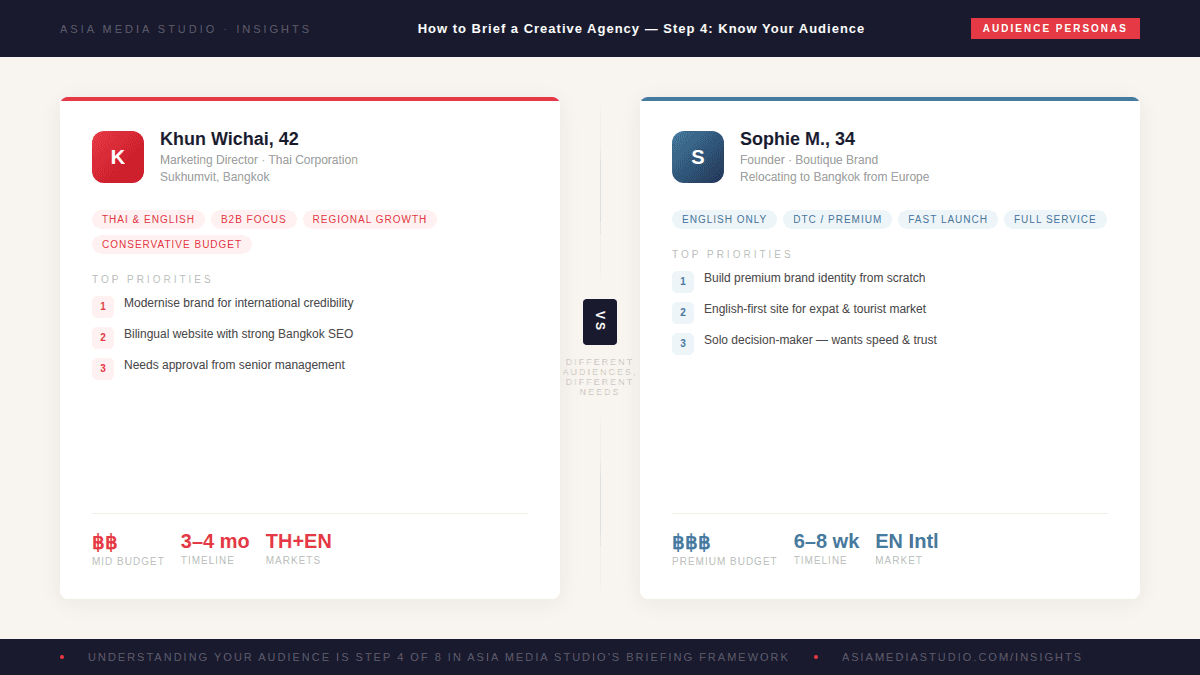
Step 4: Target Audience
Who are you trying to reach — and what do you know about them?
This is often the most underdeveloped section in client briefs. Yet it's where the most creative value gets unlocked.
Demographics: age range, gender, income level, occupation
Psychographics: values, lifestyle, what they care about
Geography: Bangkok only, Thailand-wide, or international?
Language: Thai, English, or both?
Where they currently find you: search, social, referral, walk-in?
If you serve multiple audiences (e.g., Thai corporate clients and expat families), describe each one separately. A good agency will design different touchpoints for different people.
Step 5: Competitors & Market Context
Who else is in your space — and what sets you apart?
Share who your main competitors are and how you differ from them. This is not about criticizing rivals — it's about helping the agency position you correctly.
Name 3–5 competitors and briefly describe their brand positioning
What do they do well? What do they do poorly?
Where is the gap in the market that you occupy (or want to occupy)?
If there are brands — inside or outside your industry — whose visual identity or tone of voice you admire, mention them. This gives the creative team an invaluable reference point.
See how AMS approaches competitive positioning — selected case studies |
Step 6: Brand Personality & Tone
What should your brand feel like?
Creative teams think in feelings before they think in pixels. Describe your brand in human terms:
If your brand were a person, how would they dress and speak?
Choose 3–5 adjectives: bold, warm, minimal, playful, authoritative, international...
What should customers feel when they interact with you? (Confident, excited, reassured, inspired?)
Are there any visual directions you definitely want to avoid?
Example: 'We want to feel like a premium boutique consultant — knowledgeable and calm, not corporate and cold. Think less Big 4, more specialist advisor.'
Related AMS services |
Step 7: Deliverables, Timeline & Budget
The practical reality of the project.
This section determines whether the project is feasible. Be honest — especially about budget.
List every deliverable you expect (logo files, website pages, ad templates, social content, etc.)
Provide your target launch or go-live date
Share your budget range, even if it's approximate
On budget: Many clients in Bangkok hesitate to share budget. Don't. A good agency will design the best possible solution within your range. Without knowing the budget, they may propose either too much (wasting your time evaluating a solution you can't afford) or too little (underselling what you could actually achieve).
AMS approach: We always have an honest conversation about scope vs. budget in our first consultation. It saves both parties from disappointment.
Step 8: Decision-Making & Approval Process
Who is involved, and how decisions get made.
Creative projects often slow down not because of creative challenges, but because of internal approval bottlenecks. Tell the agency upfront:
Who is the primary contact at your company?
Who else will be reviewing and approving creative work?
How many rounds of feedback are typical in your organization?
Are there any legal, compliance, or brand governance requirements?
The more the agency knows about your internal process, the better they can structure timelines and manage expectations — on both sides.
Common Brief Mistakes Bangkok Businesses Make
After reviewing thousands of briefs, we see the same mistakes repeatedly. Here's what to avoid:
Skipping the audience section
'Everyone is our customer' is not a target audience. The more specific you are, the more targeted and effective the creative will be. Trying to speak to everyone guarantees you'll connect with no one.
Providing a solution instead of a problem
Many clients brief an agency by saying 'We want a red logo with a tiger.' What they should be saying is 'We want to feel bold and powerful in a market that currently sees us as safe and forgettable.' Give the agency the problem — let them find the best creative solution.
No reference points
Even three or four examples of brands, websites, or campaigns you admire — with a note on what specifically you like — saves hours of creative misalignment.
Unrealistic timelines or budgets
A full brand identity with a new website, delivered in two weeks, for 50,000 Baht, is not realistic. Having an honest conversation about timeline and budget upfront prevents wasted effort on both sides.
Too many decision-makers
When ten people need to approve a logo, you end up with design-by-committee. Identify one or two key stakeholders and give the agency a clear point of contact. This is especially important in Thai corporate culture, where hierarchy can slow down feedback loops.
A Brief is the Start of a Relationship
A creative brief is not just a task document — it's the foundation of your working relationship with the agency. The better the brief, the faster the team gets up to speed, the fewer revision cycles are needed, and the more budget gets spent on great creative rather than re-work.
At Asia Media Studio, our first consultation is always a discovery conversation — we ask many of these questions directly and help clients build a brief that gives our team the best possible start. Whether you need branding strategy, a new website, SEO, or social media marketing — we start every engagement by getting the brief right.
Whether you're launching a startup in Thonglor or repositioning an established brand on Silom, a strong brief sets the tone for everything that follows.
Ready to Start Your Project?
Get in touch with our team at Asia Media Studio. We'll guide you through the briefing process and help turn your goals into a clear, actionable project scope.
asiamediastudio.com/contact · info@asiamediastudio.com · 02 663 59 30
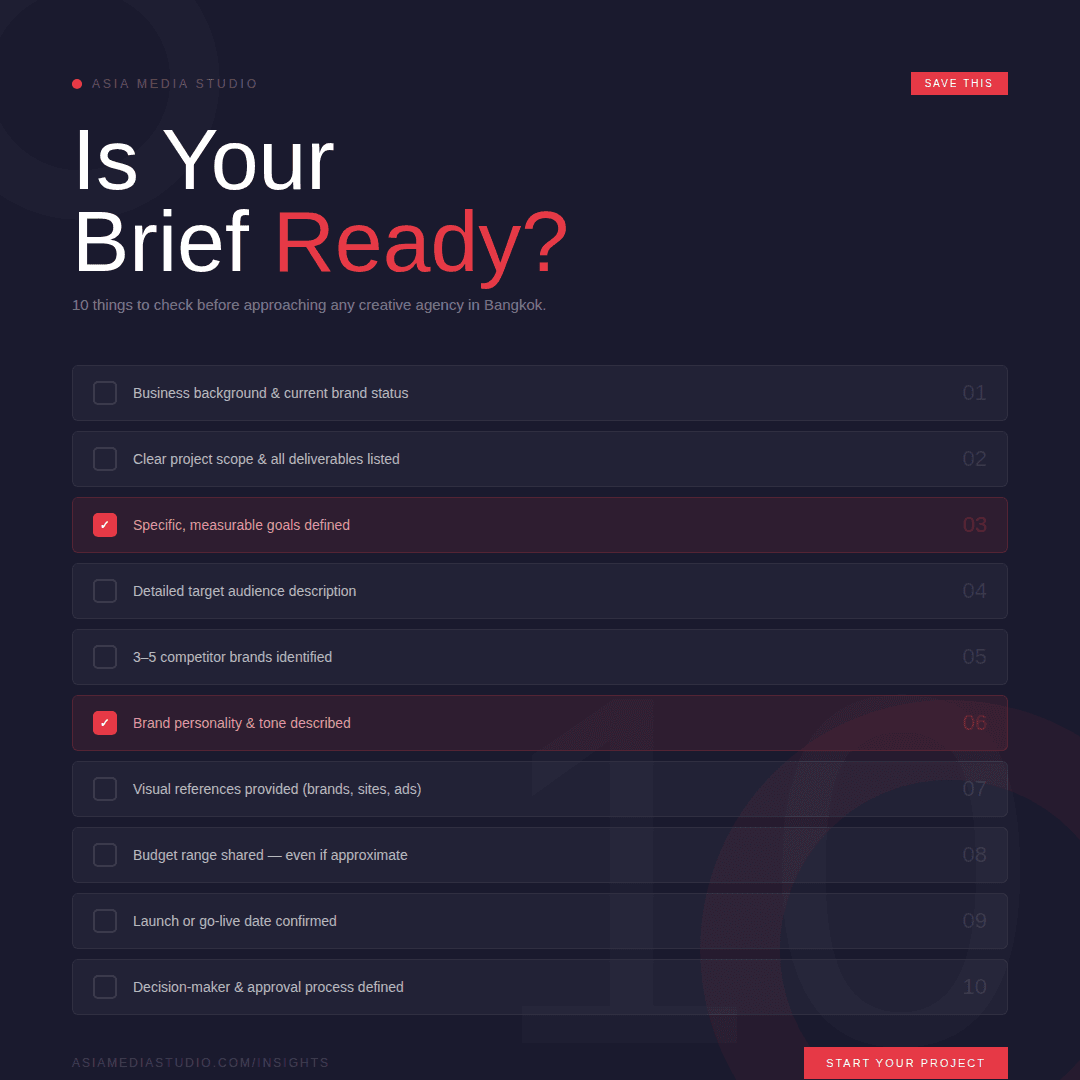
Quick Checklist: Is Your Brief Ready?
Use this checklist before submitting a brief to any creative agency:
Business background and current brand status
Clear project scope and deliverables
Specific, measurable goals
Detailed target audience description
3–5 competitor brands identified
Brand personality and tone described
Visual references provided (websites, brands, campaigns)
Budget range shared (even approximate)
Launch or go-live date confirmed
Decision-maker and approval process defined
Further Reading
If you found this guide useful, explore more from the AMS Insights library:
The Critical Role of UX Research in Website Projects
What Is Branding or Brand Marketing?
A Guide to Creating Strong Website Branding with Examples
Why SEO Is Essential for Business Growth
Guide to Digital Inbound Marketing in 2025
Our Comprehensive Logo Design Process Explained – 8 Essential Steps
See what a great brief can produce — browse the AMS portfolio → AIS — Corporate branding & print → American School of Bangkok — UX/UI, web & SEO → Nissan Asia & Oceania — Branding & communication design → Power Buy — Digital marketing & social media |

Let’s keep in touch.
Follow Asia Media Studio for design insights and updates on Facebook, Instagram, and LinkedIn.