Thailand is often grouped into broader "Southeast Asia" marketing plans, treated as a market you can enter with the same playbook used in Vietnam, Indonesia, or the Philippines with a few words swapped out. That approach explains why so many brands, both international and Thai-owned, plateau here. The visual identity looks fine. The message technically makes sense. But it never quite lands the way it does at home.
Branding in Thailand that actually works is built on cultural fluency, not just visual polish. This article looks at the specific cultural forces, some centuries old, some Gen Z and TikTok-driven, that shape whether a brand feels trustworthy, relevant, and likeable to Thai audiences: language and regional identity, social values like sanuk and kreng jai, belief systems around fortune and timing, the platforms Thai consumers actually trust, and what all of this means practically for anyone building or refreshing a brand here.
The Translation Trap
The most common mistake is treating localization as a translation task: take the English brand book, hand it to a translator, swap the copy, ship it. This is where things go wrong first, because language in Thailand carries more than literal meaning.
A well-known cautionary example comes from a Swedish furniture retailer's Thailand launch, where several Scandinavian product names translated into words that were, at best, unintentionally funny and, at worst, vulgar in Thai. The mistake wasn't a bad translator. It was skipping the step of having native Thai speakers and cultural insiders stress-test the brand before it reached the public. Social media did the rest, and the brand spent its early weeks in Thailand managing a joke instead of building a reputation.
Contrast that with brands that have succeeded by rethinking their message for a Thai audience rather than converting it word for word: adjusting humor, adding regionally relevant products, and building campaigns that feel like they were made for Thailand, not translated into it. That distinction, adapting the message versus translating the words, is the line between a brand that resonates and one that gets mocked.
The practical takeaway: brand names, taglines, and campaign concepts need a native-speaker and cultural review before launch, every time, no exceptions, regardless of how well they tested in another market.

Thailand Is Not One Market: Regional and Generational Layers
One of the quieter mistakes brands make is assuming "Thai" describes a single, uniform audience. It doesn't. Thailand has four major regional dialect groups, Central Thai (the Bangkok-based national standard used in media, education, and most advertising), Isaan in the northeast, Northern Thai around Chiang Mai and the old Lanna kingdom, and Southern Thai closer to the Malaysian border. Each carries its own vocabulary, tone, and cultural reference points, and each region has its own regional food, humor, and pace of life that shows up in how people respond to advertising.
Most Thais are functionally bilingual within their own country: they speak their regional dialect at home and with friends, then switch fluently into Standard Central Thai for professional or formal contexts, including most national advertising. This has a direct branding implication. A national campaign in polished Central Thai will be understood everywhere, but it can also feel slightly distant or "Bangkok" to audiences outside the capital. Brands that want to build genuine grassroots credibility in the northeast, the north, or the south sometimes get more traction by working regional expressions, humor, or talent into localized versions of a campaign, rather than running one Bangkok-made execution nationwide and assuming it lands the same way everywhere.
Generational layering compounds this. Bangkok-based Gen Z, provincial Gen X, and Bangkok's older, wealthier consumer base can have almost entirely different media diets, aspirations, and trust triggers, even within the same household. A brand's positioning might need to flex more across these lines in Thailand than in more culturally uniform markets, and "Thai market strategy" is often better framed as several overlapping audience strategies rather than one.

Sanuk: Why "Fun" Is a Brand Currency in Thailand
Thai culture places real value on sanuk, roughly translated as "fun," but better understood as the belief that even ordinary, mundane tasks should carry some lightness and enjoyment. It has roots in agricultural life, where songs, jokes, and teasing made long days of fieldwork bearable. Today it shows up everywhere: in how Thais socialize, how they shop, and how they expect brands to talk to them.
For branding, this matters more than it sounds. A brand voice that is purely functional, purely corporate, or overly serious can come across as cold, even in categories like finance, healthcare, or B2B where brands elsewhere lean formal. Thai audiences respond well to brands that let a little personality and playfulness through, in copywriting, in social content, in packaging, even in customer service scripts. This doesn't mean every brand needs to be jokey. It means brand tone of voice guidelines built for Thailand should deliberately leave room for warmth and lightness, rather than importing a strictly formal tone wholesale from a headquarters in another region.
Kreng Jai and Jai Yen: Harmony Over Confrontation
Two related concepts shape how Thais communicate, and both have direct consequences for brand messaging and customer experience design.
Kreng jai describes a deep awareness of other people's feelings, paired with a reluctance to impose, criticize directly, or cause someone to lose face. Jai yen, literally "cool heart," describes emotional restraint: Thais generally avoid visible anger or confrontation, preferring calm, indirect responses even in frustrating situations.
This has a few concrete implications for branding:
Advertising tone. Aggressive comparison advertising, hard-sell pressure tactics, and confrontational "us versus them" positioning tend to underperform in Thailand compared to markets where directness is prized. Messaging that respects the audience's autonomy and avoids pushing too hard tends to build more trust over time.
Customer feedback and reviews. Thai customers who are unhappy will often not complain directly, choosing instead to quietly stop buying or to vent on social media rather than to a brand's face. Brands that only monitor direct complaints will systematically miss dissatisfaction. This is a strong argument for social listening as part of brand health tracking in Thailand, not just direct feedback channels.
Service recovery. Because losing face matters so much, how a brand handles a mistake in public (a delayed order, a defective product, a billing error) needs to preserve the customer's dignity, not just solve the logistical problem. A brand's crisis response tone of voice deserves as much strategic attention as its everyday marketing voice.

Thai-ness: Language, Buddhism, and the Monarchy
Thai identity is often described as resting on three pillars: the Thai language, Buddhism, and reverence for the monarchy. Brands do not need to incorporate these directly to succeed, but they do need to navigate them with care.
Buddhist values around modesty, respect for elders, and non-materialism (even in a highly consumerist market) shape what feels tasteful versus tone-deaf in advertising. Overt boastfulness, aggressive status signaling, or imagery that could be read as disrespectful of monks, temples, or royal symbols carries far higher reputational risk in Thailand than in many other markets, and the sensitivity extends to seemingly small details: colors, symbols, and even how currency or royal portraits are depicted in creative work.
There is also a practical regulatory dimension worth knowing. Thailand restricts alcohol advertising quite strictly, and around certain Buddhist holy days, most visibly during Buddhist Lent (Khao Pansa), there is strong social and sometimes formal pressure against promoting alcohol at all. Brands in adjacent categories, like nightlife, events, or hospitality, often need a quieter creative approach during these windows, not because the law always requires it, but because running a loud, celebratory campaign against the grain of a solemn religious period reads as tone-deaf.
The safe and effective approach is straightforward: build cultural and religious-calendar sensitivity checks into the creative approval process itself, rather than relying on a single reviewer's judgment call at the end. This is a place where local expertise is not optional.

Color, Numbers, and a Little Superstition
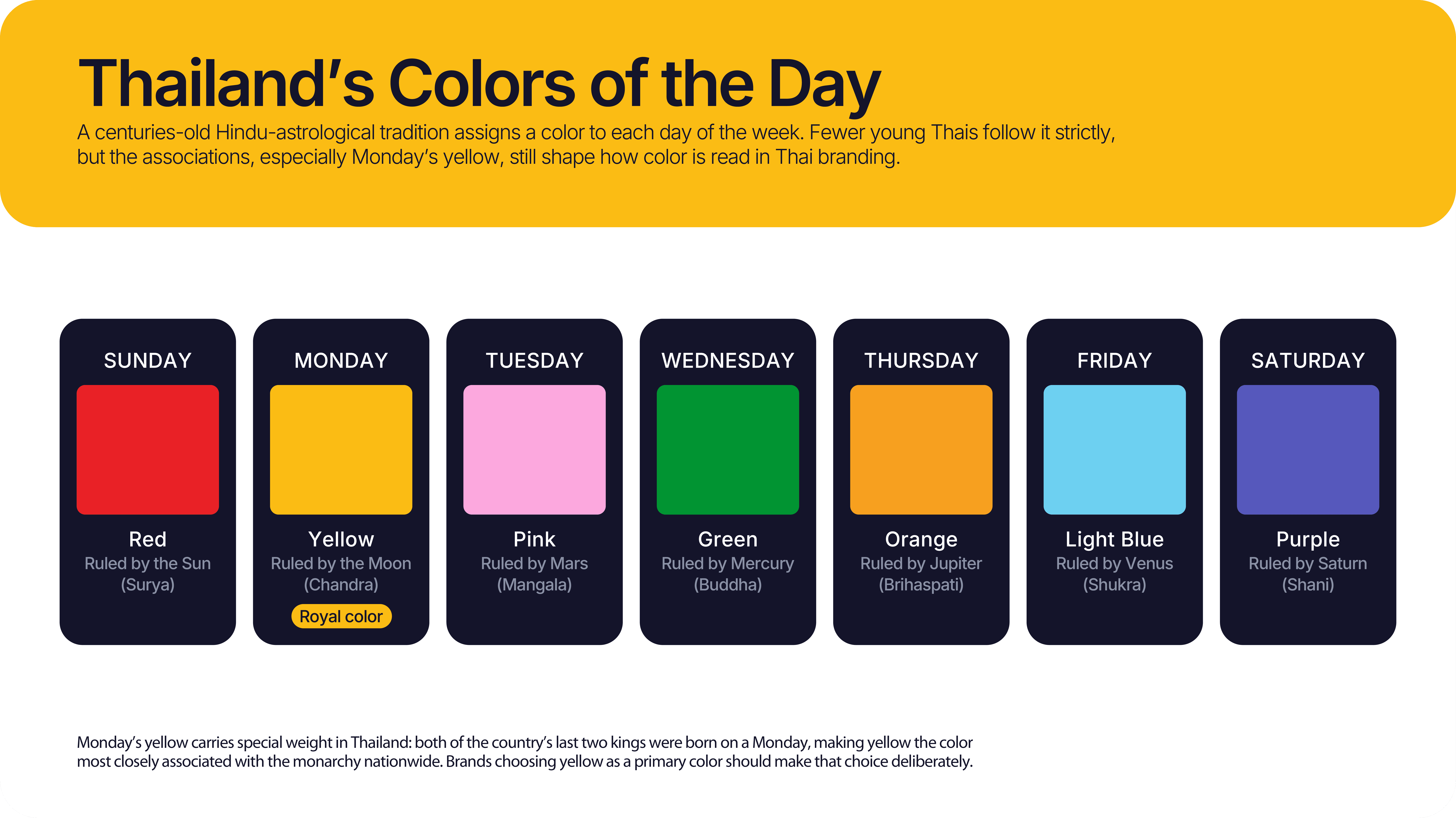
Thailand has a centuries-old tradition, rooted in Hindu-astrological belief, of assigning a color to each day of the week: red for Sunday, yellow for Monday, pink for Tuesday, green for Wednesday, orange for Thursday, blue for Friday, and purple for Saturday. Fewer young Thais follow this strictly day-to-day, but the tradition still shapes color perception in ways brand teams should know about.
Yellow in particular carries outsized meaning. Both of Thailand's last two kings were born on a Monday, and yellow became strongly associated with the monarchy as a result, worn nationwide during royal celebrations. A brand choosing yellow as a primary color isn't wrong to do so, but should understand the association it's stepping into, and should make sure the choice is deliberate rather than accidental.
Numbers carry weight too. Reflecting Thailand's large Thai-Chinese population and shared regional beliefs, numbers like 8 and 9 are widely considered auspicious (9 in particular, linked to the Thai word for "progress"), while 4 is often avoided in pricing, phone numbers, and building floors due to its association with the word for "death" in Chinese-influenced numerology. None of this needs to dominate a brand strategy, but it is worth a deliberate check during naming, pricing, and packaging design rather than leaving it to chance.
Belief, Fortune, and Timing: What Astrology and Amulets Mean for Business
This is a layer that rarely appears in international brand strategy training, and it can meaningfully affect how a launch is received in Thailand.
Fortune-telling and astrology are mainstream, not fringe, in Thai business culture. It is common practice for entrepreneurs, executives, and even senior political figures to consult an astrologer before a major decision: a company registration, a store opening, a product launch, or a significant investment. The 2019 royal coronation itself was scheduled around a date selected by court astrologers, which reflects how deeply timing-by-belief runs through formal Thai institutions, not just small business owners. It is not unusual for a Thai business partner or client to ask, sincerely, whether a proposed launch date has been checked for auspiciousness, and dismissing the question can come across as culturally careless even if no one insists on acting on the answer.
Spirit houses (san phra phum) are another visible piece of this belief system. Many Thai homes, offices, hotels, and retail locations keep a small shrine on the property to house the spirits displaced by construction, and the shrine's placement, size, and upkeep are taken seriously as a matter of respect and good fortune for the business. Amulets, similarly, are a genuine cultural subculture in Thailand, worn or displayed by people across income levels for protection and luck, and Thailand's amulet market itself is large enough to be a small economy.
None of this means a brand needs to incorporate spirit houses or astrology into its identity. What it does mean is that when Thai staff, partners, or landlords raise these considerations during a launch, whether that's picking an opening date, choosing a shop location, or the placement of a shrine on new retail premises, it should be treated as a legitimate business input worth accommodating where reasonably possible, not humored or dismissed. Brands and agencies that show respect for this layer tend to build smoother, more trusted working relationships with Thai partners generally.
The Cultural Calendar: Timing Campaigns Around Festivals and Beliefs
Thailand's calendar of festivals is not just a backdrop for seasonal promotions, it is one of the highest-leverage windows for brand visibility, and getting the tone right matters as much as showing up at all.
Songkran (mid-April) is Thailand's most commercially significant festival, marking the traditional Thai New Year with days of water fights, family reunions, and a strong "fresh start" emotional theme nationwide. Many major brands build entire annual campaign cycles around it, and the emotional territory (renewal, togetherness, cleansing the old year) tends to outperform generic "big sale" messaging.
Loy Krathong (November) centers on floating a decorated krathong on water to release misfortune, carrying a softer, more romantic and reflective emotional tone than Songkran's high-energy water fights. Campaigns that lean into gratitude, family, or quiet reflection tend to fit the mood of the festival better than aggressive discounting.
Chinese New Year matters more in Thailand than its official status suggests, given the significant Thai-Chinese presence throughout the country's business community. Red and gold color schemes, lucky-number pricing, and gifting-oriented promotions around this period can resonate strongly, particularly for brands in retail, F&B, and financial services.
Buddhist Lent (Khao Pansa) and other religious observances, as noted above, call for a quieter creative posture, especially for alcohol-adjacent categories. Brands with an always-on promotional calendar should build a deliberate "quiet mode" for these windows rather than running business-as-usual creative straight through them.
The practical implication for brand strategy is that a Thailand content and campaign calendar should be built around this festival rhythm from the outset, not retrofitted with a generic seasonal promo plan borrowed from another market.

The Digital-First Gen Z Thai Consumer
Thailand's younger consumers are reshaping what a "brand touchpoint" even means, and any brand built without this in mind will feel dated fast.
Thai Gen Z over-indexes heavily on TikTok and Instagram compared to older generations: roughly three-quarters use TikTok and close to nine in ten use Instagram, and more than half spend two or more hours a day on TikTok alone, a rate several times higher than older cohorts. Their primary use of these platforms isn't passive browsing. A large share watch live shopping broadcasts directly from sellers, follow creators and celebrities closely, and treat social platforms as a genuine discovery and purchase channel, not just an awareness tool.
This changes what a brand identity system needs to do. A logo and color palette designed only for a storefront sign or a print ad won't survive well in a live-stream thumbnail, a nine-second TikTok intro, or a KOL's unboxing video. Brand identity in Thailand increasingly needs to be built "video-first" and "creator-compatible" from the start: flexible enough to look right in a livestream overlay, distinct enough to be recognizable in a six-second clip, and adaptable enough for creators to use it authentically rather than as a rigid corporate asset bolted onto their content.
LINE, Trust, and the Real Customer Service Layer
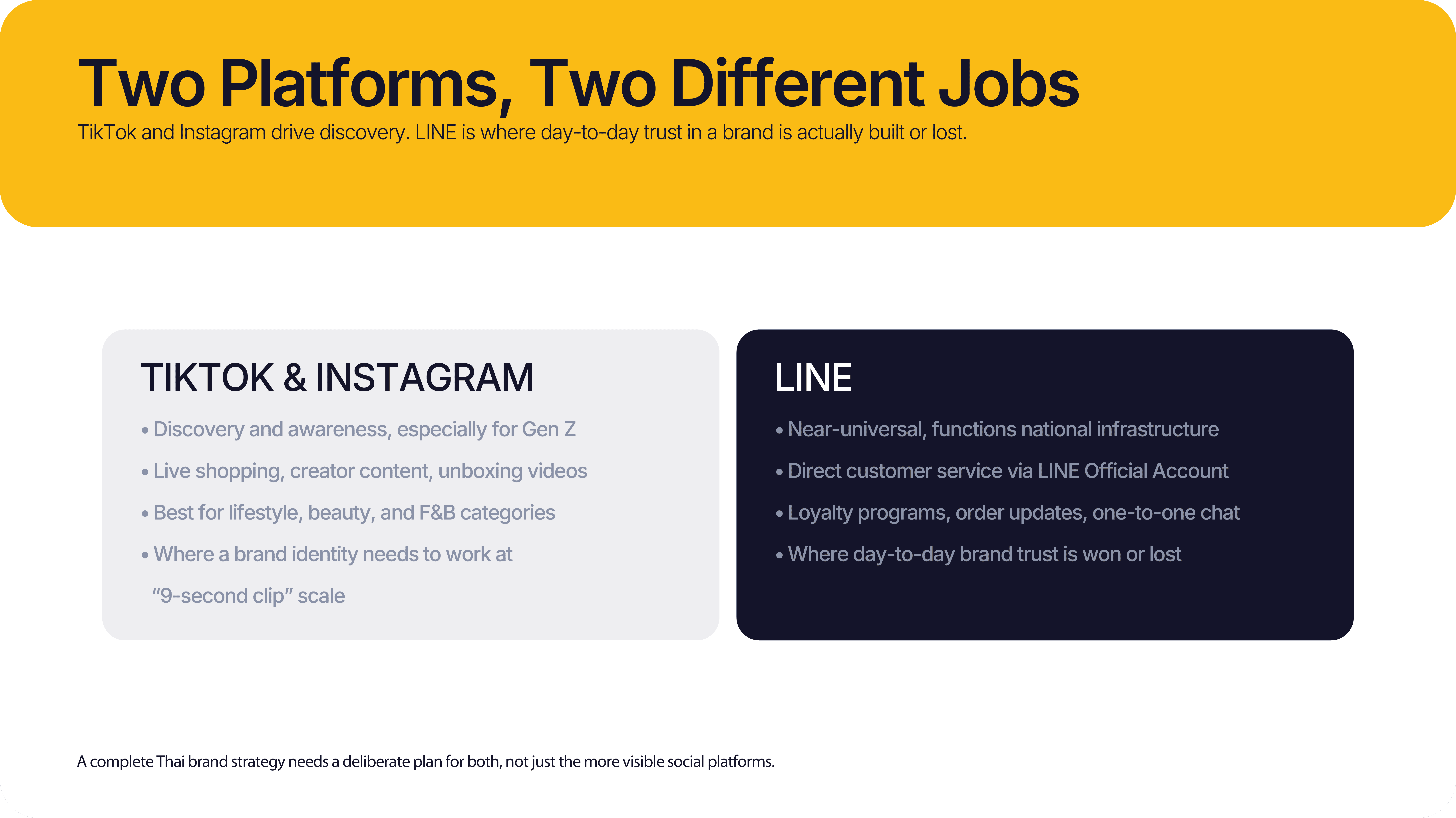
Any conversation about Thai digital behavior that stops at TikTok and Instagram is missing the platform many Thai consumers actually use to talk to brands directly. Thailand is one of LINE's handful of core global markets, alongside Japan, Taiwan, and Indonesia, and LINE functions less like a messaging app and more like national infrastructure: banks send transaction alerts through it, government services notify citizens through it, and a large share of small and large businesses run customer service, loyalty programs, and even ordering directly through a LINE Official Account.
For branding, this matters in a very concrete way. A Western-style customer journey that assumes email as the trust-building channel of record, order confirmations, support tickets, loyalty updates, will miss most Thai consumers' actual expectations. Thai consumers routinely expect to message a brand's LINE account and get a real, fairly quick response, and that conversation, more than a polished ad, is often where day-to-day brand trust is actually built or lost. Brand voice guidelines built for Thailand should explicitly cover how the brand sounds in a one-to-one LINE chat, not just in broadcast advertising, because for many customers that chat is the brand.
KOL Culture: Presenters, Micro-Creators, and Borrowed Trust
Influencer marketing in Thailand is more structured, and arguably more mature, than in many Western markets, and it plays a bigger role in how a brand's credibility gets built.
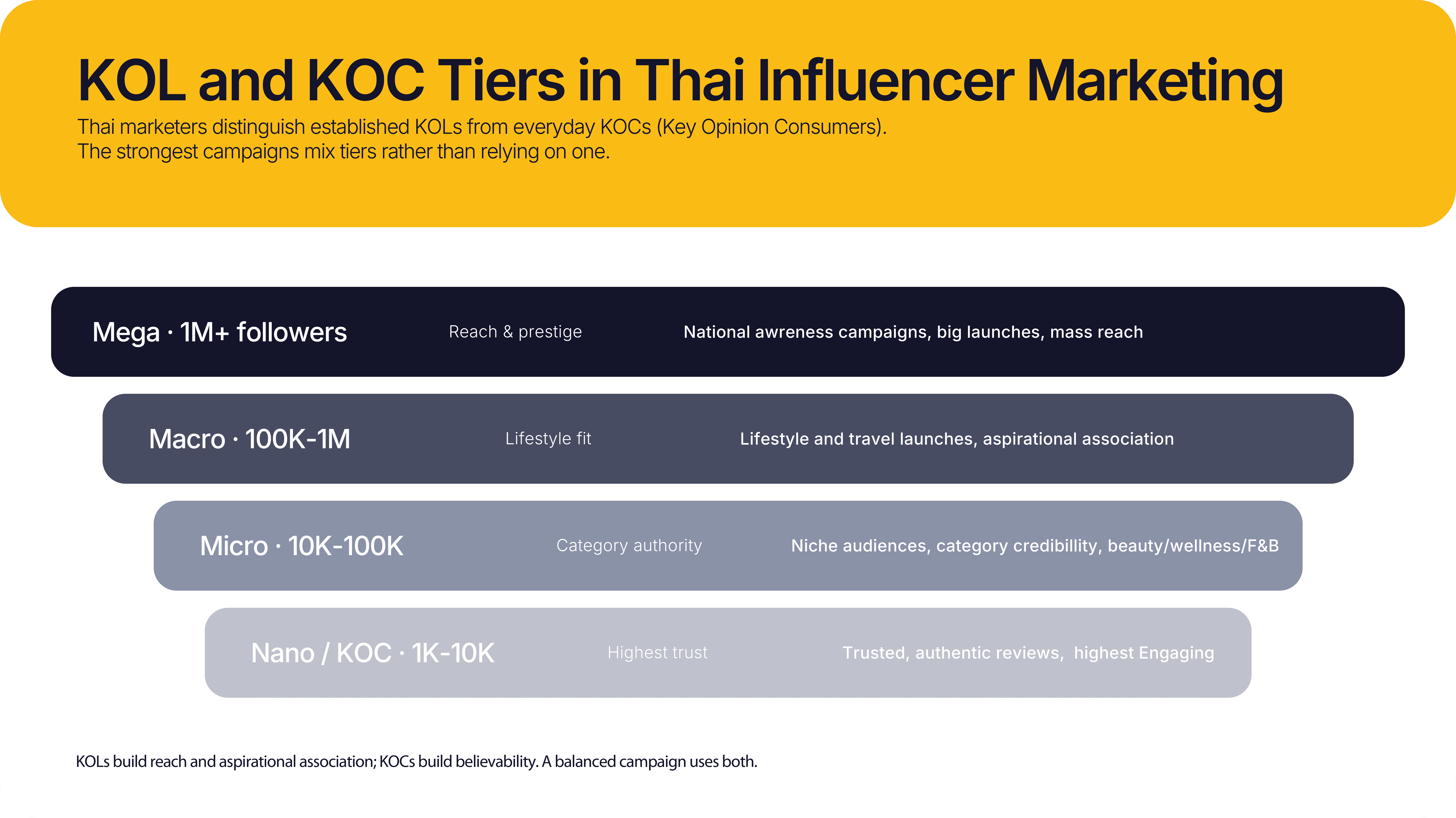
Thai marketers commonly distinguish between Key Opinion Leaders (KOLs), established creators with professional rates and produced content, and Key Opinion Consumers (KOCs), everyday users who post authentic, often unpolished reviews at a smaller scale. The two serve different jobs: KOLs build reach and aspirational association, while KOCs build believability, because their content reads as a genuine recommendation rather than a paid placement. A well-run brand campaign in Thailand usually blends creator tiers deliberately, mega and macro names for national awareness, micro-creators for category authority in categories like beauty, wellness, or F&B, and nano-creators or KOCs for the kind of grassroots social proof that a Thai audience, primed by kreng jai and indirect trust-building, tends to find more credible than direct brand messaging.
Platform choice matters here too. TikTok and Instagram tend to carry lifestyle, beauty, and F&B content best. Facebook and YouTube still carry weight for commerce-oriented and longer-form content, particularly with older audiences. LINE, again, plays a distinct role, less about discovery and more about direct-to-consumer loyalty and retention once someone has already converted.
For a brand's identity and voice, this means designing brand assets, especially logos, color systems, and short-form templates, that translate cleanly into creator-made content, since a meaningful share of a Thai brand's actual audience impressions will come through someone else's video, not the brand's own channel.
What This Means in Practice
Pulling these threads together, a handful of practical principles emerge for anyone building or refreshing a brand for the Thai market.
Treat translation as the last step, not the localization strategy itself. Every name, tagline, and campaign concept deserves a native cultural review before launch, not a translation pass after the creative is locked.
Plan for more than one Thailand. Regional dialect, humor, and pacing differences mean a single Bangkok-made execution may not travel as well to the northeast, north, or south as headquarters assumes, and generational differences can be just as wide within a single city.
Leave room for warmth in the brand voice, even in serious categories, because Thai audiences respond to brands that feel human and a little playful rather than purely transactional.
Design the customer experience for indirect feedback. If a brand only listens for direct complaints, it is missing most of the signal in a culture where confrontation is avoided.
Handle mistakes with dignity, not just efficiency. How a brand recovers from an error matters as much as how fast it responds.
Treat color, symbolism, and monarchy-related sensitivity as a formal check in the creative process, not an afterthought caught (or missed) at final review.
Respect the belief layer around timing and place. When Thai partners, staff, or landlords raise questions about auspicious dates or the placement of a spirit house, treat it as a legitimate part of the launch plan.
Build the annual content calendar around Thailand's actual festival rhythm (Songkran, Loy Krathong, Chinese New Year, Buddhist Lent) rather than a generic seasonal promotions template.
Design the identity system for short-form video and creator content from day one, because that is where a large and fast-growing share of Thai consumers, especially Gen Z, actually meet brands for the first time.
Give LINE the same strategic attention as the brand's main social channels, since for many Thai customers a one-to-one LINE conversation is where trust in the brand is actually won or lost.
None of this replaces the fundamentals of good brand strategy. Positioning, differentiation, a clear value proposition, and consistent execution still matter as much here as anywhere. What changes in Thailand is the layer of judgment sitting on top of those fundamentals: which words land well, which visuals feel respectful, which tone builds trust, and which shortcuts (like a straight translation, or a generic seasonal calendar) quietly undermine everything else a brand is trying to build.
A Quick Cultural Fit Audit
Before a brand launches or refreshes in Thailand, it is worth running the identity, messaging, and campaign plan through a short set of honest questions:
Has every name, tagline, and key line of copy been reviewed by a native Thai speaker for unintended meaning, not just accuracy of translation?
Does the brand voice have room for warmth and lightness, or does it read as strictly formal and imported wholesale from another market?
Has the color palette and any numbers used in pricing or naming been checked against Thai cultural and superstitious associations, even briefly?
Is there a plan for how the brand sounds and behaves in a one-to-one LINE conversation, not just in broadcast advertising?
Does the annual campaign calendar account for Songkran, Loy Krathong, Chinese New Year, and Buddhist religious observances, rather than treating Thailand like a generic market with a generic promo calendar?
Would the brand's identity system still look and feel right inside a nine-second TikTok clip or a livestream overlay, not just on a storefront sign or a printed brochure?
If a launch date or store location has been flagged as a concern by Thai staff or partners, has that concern been genuinely accommodated where reasonably possible?
A brand that can answer yes to most of these has done real localization work. A brand that has only translated its existing materials has not, no matter how polished those materials are.

How AMS Approaches This
At AMS, our brand strategy work across sectors in Thailand, from cosmetics and wellness to F&B, retail, and professional services, has reinforced the same lesson repeatedly: the brands that build lasting traction here are the ones that treat Thai cultural context, regional, religious, social, and digital, as a strategic input from day one, not a localization checklist applied after the identity is already designed elsewhere. That means involving Thai-market insight at the positioning stage, not just at the translation stage, building identity systems flexible enough to work across a billboard, a LINE OA chat, and a nine-second TikTok clip, and planning campaigns around Thailand's actual cultural calendar rather than a generic one.
If you're building a new brand for Thailand or reworking one that isn't landing the way it should, that cultural layer is usually the missing piece, not the visual identity itself.
Frequently Asked Questions
Is it enough to just translate my brand's messaging into Thai? No. Literal translation frequently produces phrasing that feels awkward, unintentionally funny, or occasionally offensive, because words that work in one language can carry entirely different associations in Thai. Effective branding in Thailand requires adapting the message and tone for a Thai audience, with native speakers and cultural reviewers involved before launch, not just converting the words.
Do I need to use "lucky" colors or numbers in my branding? Not necessarily, but you should make an informed choice rather than an accidental one. Colors like yellow carry strong monarchy associations, and numbers like 4 carry negative associations for many Thai and Thai-Chinese consumers. Understanding these associations lets a brand choose deliberately, whether that means leaning into them or consciously avoiding them.
How does Thai communication style affect advertising tone? Thai culture generally favors indirectness, harmony, and avoiding confrontation over aggressive, confrontational, or hard-sell messaging. Advertising that respects the audience's autonomy and avoids pushing too hard, or putting anyone in an awkward position, tends to build more trust than direct comparison or high-pressure tactics.
Why does Gen Z matter so much for brand identity design in Thailand? Thai Gen Z consumers spend disproportionately more time on TikTok and Instagram than older generations, and a large share discover and buy products through livestreams and creator content rather than traditional advertising. Brand identities that were only designed for static, print-style use often perform poorly in short-form video and live commerce, which is where a growing share of first brand impressions now happen.
Is Thailand really one market, or does it vary by region? It varies meaningfully. Thailand has distinct regional dialects and cultural identities across the Central, Isaan, Northern, and Southern regions, and a national campaign made for a Bangkok audience does not automatically resonate the same way in the provinces. Brands aiming for genuine grassroots traction outside Bangkok often benefit from regionally adapted messaging, talent, or media choices.
How important is LINE compared to Instagram or TikTok for branding in Thailand? Very important, though it plays a different role. TikTok and Instagram tend to drive discovery, awareness, and creator-led content, while LINE functions as the trusted, direct customer service and loyalty channel for a large share of Thai consumers. A complete Thai brand strategy needs a deliberate plan for both, rather than treating LINE as an afterthought behind the more visible social platforms.
Do beliefs like auspicious dates or spirit houses really affect business decisions in Thailand? Yes, for a meaningful share of Thai businesses and consumers. Consulting an astrologer before a major launch, or maintaining a spirit house at a business property, is mainstream practice across many income levels and business sizes in Thailand, not a fringe belief. Brands and agencies do not need to adopt these practices themselves, but treating the topic with respect when Thai partners or staff raise it tends to build smoother, more trusted working relationships.
Can an international brand keep its global identity and still succeed in Thailand? Often yes, but usually with adaptation rather than a wholesale copy-paste. The core positioning and visual system can often stay consistent globally, while tone of voice, campaign concepts, color usage, content formats, and the annual campaign calendar get a deliberate Thai-market layer. The brands that struggle are usually the ones that skip that layer entirely.


Restons en contact.
Suivez Asia Media Studio pour des conseils en matière de design et des mises à jour sur Facebook, Instagram et LinkedIn.