
Why SEO Still Matters for Businesses in Thailand
Google holds between 97 and 98 percent of search market share in Thailand. That is an overwhelming majority of how Thai consumers discover businesses, products, and services online. When someone types a query into Google, appearing on the first page is the difference between getting found and being invisible.
Paid advertising can deliver fast results, but it stops the moment you stop paying. SEO, on the other hand, builds long-term visibility. Once you rank well for the right keywords, you continue to attract visitors without an ongoing ad spend. This makes SEO one of the highest-ROI marketing channels for businesses of any size.
Consider some real-world context. A Bangkok boutique retailer that invested consistently in SEO saw a 200 percent increase in foot traffic by ranking first for relevant local search terms. A real estate company targeting luxury condos experienced a 300 percent rise in qualified leads within six months of implementing targeted keyword optimisation and local SEO. These numbers are not unusual when SEO is done correctly.
The Thai digital landscape is growing fast. Internet users in Thailand continue to increase year after year, and Thai consumers spend nearly eight hours per day online. Social media users in the country now exceed 49 million. This means the potential audience for your business through organic search is massive, and it is only getting larger.
The SEO Landscape in 2026: What Has Changed
SEO in 2026 looks very different from even two years ago. The biggest shift is the rise of AI in search. Google now displays AI-generated summaries, called AI Overviews, for many search queries. These summaries pull information from multiple sources and present a direct answer before the traditional list of links.
AI Overviews and Generative Engine Optimisation (GEO)
AI Overviews appear in roughly 5 to 13 percent of all search queries, and they are especially common for informational searches. When an AI Overview appears, the click-through rate to traditional organic results drops. This means your content must be structured in a way that AI systems can understand, extract, and cite.
This is where Generative Engine Optimisation, or GEO, comes in. GEO is the practice of structuring your content so that AI platforms like Google’s AI Overviews, ChatGPT, Gemini, and Perplexity can easily understand it and recommend your brand. It is not a replacement for traditional SEO. It is a new layer on top of it.
The key principles of GEO include writing clearly structured content with logical headings, providing concise answers to specific questions, including unique data and insights that AI cannot find elsewhere, and building strong E-E-A-T signals (Experience, Expertise, Authoritativeness, and Trustworthiness). Brands that do this well are more likely to be cited in AI-generated answers.
The Rise of AI Search Platforms
Google is no longer the only place where people search. Platforms like ChatGPT, Perplexity, and Gemini are increasingly used by consumers to research products, compare services, and make decisions. Total search usage, combining traditional search engines and AI platforms, has increased by 26 percent worldwide. The pie is getting bigger, not smaller.
For businesses in Thailand, this creates both a challenge and an opportunity. The challenge is that you now need to be visible across multiple platforms, not just Google. The opportunity is that brands investing in quality content and strong online authority will be surfaced by AI systems alongside, or even instead of, larger competitors.
Traditional SEO Is Still the Foundation
Despite the hype around GEO, traditional SEO remains the primary source of high-intent traffic. Research shows that 60 percent of businesses have not yet seen a significant traffic impact from AI-assisted search. SEO traffic still converts at higher rates because users who click through to your website have demonstrated clear intent.
The smartest approach in 2026 is a balanced strategy: build strong SEO foundations first, then layer GEO practices on top. This way, you are visible in both traditional search results and AI-generated responses.
3. The Core Pillars of SEO for Thai Businesses
A successful SEO strategy rests on several interconnected pillars. Let us walk through each one with a focus on what matters specifically for businesses operating in Thailand.
Technical SEO: Building a Strong Foundation
Technical SEO is the behind-the-scenes work that ensures search engines can crawl, understand, and index your website efficiently. Without a solid technical foundation, even the best content will struggle to rank. The key areas to focus on include site speed and Core Web Vitals, mobile-first design, clean URL structures, proper indexing setup, structured data markup, and HTTPS security.
In Thailand, mobile traffic dominates. Most Thai consumers access the internet primarily through smartphones. Your website must perform flawlessly on mobile devices, with fast load times, easy navigation, and readable text without zooming. Google uses mobile-first indexing, which means it evaluates the mobile version of your site first when deciding how to rank it.
Site speed is critical. Thai users are impatient. If your page takes more than three seconds to load, you will lose a significant portion of visitors. Optimise images, use a content delivery network (CDN), enable browser caching, and compress your code. Tools like Google PageSpeed Insights and Lighthouse can identify specific issues to fix.
Keyword Research: Understanding What Thai Consumers Search For
Keyword research is the process of identifying the words and phrases your target customers use when searching online. In Thailand, this involves a unique complexity: bilingual search behaviour. Many Thai users search in Thai, but some search in English, and others mix both languages in a single query.
For example, someone looking for a branding agency might search for “branding agency Bangkok,” “บริษัท branding กรุงเทพ,” or a mix like “ออกแบบ brand identity.” A strong keyword strategy covers all these variations. Tools like SEMrush and Ahrefs can help identify high-value keywords and understand what your competitors are ranking for.
Focus on search intent, not just search volume. A keyword with fewer monthly searches but high commercial intent can deliver more value than a broad keyword with thousands of searches that are purely informational. Understanding why someone is searching is just as important as knowing what they are searching for.
On-Page SEO: Optimising Your Content
On-page SEO refers to the optimisations you make directly on your website pages. This includes title tags, meta descriptions, header structure, internal linking, image alt text, and content quality. Each page on your website should target a specific keyword or topic cluster and provide genuine value to the reader.
Write compelling title tags that include your target keyword naturally. Keep them under 60 characters so they display fully in search results. Craft meta descriptions that give searchers a clear reason to click. Use header tags (H1, H2, H3) to create a logical content hierarchy that both readers and search engines can follow.
Content quality is the most important on-page factor. Google’s algorithms are increasingly sophisticated at evaluating whether content genuinely helps users. Write for humans first, then optimise for search engines. Include unique insights, original data, and real examples whenever possible. This is where deep brand knowledge and industry expertise become a real competitive advantage.
Off-Page SEO: Building Authority and Trust
Off-page SEO is everything that happens outside your website to build its authority. The most important factor is backlinks: links from other reputable websites pointing to yours. These act as votes of confidence in the eyes of search engines.
In Thailand, building quality backlinks requires a localised approach. Earn links through digital PR, industry partnerships, guest contributions to respected publications, and by creating content that others naturally want to reference. Avoid low-quality link-building schemes that promise hundreds of links for a low price. These can result in Google penalties that are difficult and costly to recover from.
Brand mentions across the web also contribute to authority. When AI platforms like ChatGPT or Perplexity recommend a brand, they often pull from third-party sources rather than the brand’s own website. Research shows that brands are 6.5 times more likely to be cited through third-party sources. This makes digital PR and brand awareness efforts more important than ever.
Local SEO: Winning the Bangkok Battlefield
For businesses with a physical location or a defined service area, local SEO is essential. When someone searches for a service near them, Google displays a “Local Pack” with a map and three business listings. Appearing in this Local Pack can transform your lead generation.
The foundation of local SEO is your Google Business Profile. Claim it, verify it, and fill in every detail: accurate business name, address, phone number, hours, categories, and a thorough business description. Upload high-quality photos and respond to every review, both positive and negative.
Consistency is critical. Your business information must be identical across all online platforms: your website, Google Business Profile, Facebook, LINE Official Account, Wongnai, TripAdvisor, and any other directories. In Thailand, Wongnai and Pantip are especially important citation sources that international SEO guides often miss. These Thai-language platforms signal strong local relevance to Google.

4. How Brand Strategy Fuels SEO Success
Here is something most SEO articles will not tell you: your brand strategy and your SEO strategy are deeply connected. A well-defined brand makes every aspect of SEO more effective.
When a brand has a clear positioning, a defined target audience, and a consistent voice, the content it produces is naturally more focused and more valuable. This translates directly into better keyword targeting, higher engagement metrics, and stronger authority signals. From our experience developing brand strategies for clients across industries, from cosmetics and real estate to hardware and hospitality, we have seen how the research phase of a brand strategy project directly informs SEO content planning.
Competitive Analysis Informs Keyword Strategy
Every strong brand strategy begins with competitive research. When we analyse a client’s competitors, we look at their communication channels, their messaging, their digital presence, and the keywords they rank for. This competitive intelligence is gold for SEO planning. It reveals gaps in the market where your brand can own specific search terms that competitors are neglecting.
For example, when working with brands in the security hardware sector, our competitive analysis revealed that while competitors focused heavily on product features and price messaging in their content, none were creating educational content about security trends or installation best practices. This gap became an SEO opportunity: by creating helpful, authoritative content on those topics, the brand could capture search traffic that competitors were leaving on the table.
Consumer Insights Drive Content That Ranks
Brand strategy research includes deep consumer insights: understanding what your audience cares about, how they make decisions, and what language they use. These insights are invaluable for creating SEO content that resonates.
When your content addresses real consumer pain points in their own language, engagement metrics improve. Visitors stay longer on the page, bounce rates drop, and sharing increases. These behavioural signals tell Google that your content is genuinely useful, which supports higher rankings.
A brand strategy that includes persona development, messaging frameworks, and tone of voice guidelines creates a blueprint that content teams can follow consistently. Consistency is something search engines reward. When every piece of content on your website speaks with one clear voice about a defined set of topics, your site builds topical authority faster.
E-E-A-T and Brand Authority Go Hand in Hand
Google’s E-E-A-T framework (Experience, Expertise, Authoritativeness, Trustworthiness) is increasingly important for rankings. Brands with a well-defined strategy, strong visual identity, consistent messaging, and genuine expertise naturally score higher on these signals.
Investing in a proper brand foundation, including brand guidelines, a professional website, thought leadership content, and active industry participation, does not just build brand equity. It builds the kind of digital footprint that search engines and AI platforms use to evaluate credibility.
5. Content Marketing as an SEO Engine
Content marketing and SEO are two sides of the same coin. Without quality content, there is nothing for search engines to rank. Without SEO, your content may never reach the people who need it.
Create Content That Serves User Intent
Every piece of content on your website should target a specific search intent. There are four main types of intent: informational (the user wants to learn something), navigational (the user wants to find a specific page), commercial (the user is researching before a purchase), and transactional (the user is ready to buy).
Blog articles work well for informational and commercial intent. Service pages target transactional intent. Landing pages can address all types depending on the campaign. Map your content to the buyer journey: create awareness-stage content that attracts new visitors, consideration-stage content that builds trust, and decision-stage content that converts.
Build Topic Clusters for Topical Authority
Rather than creating isolated blog posts, build topic clusters. A topic cluster consists of a comprehensive pillar page covering a broad topic, supported by multiple related articles that go deeper into subtopics. All the related articles link back to the pillar page and to each other.
For instance, a branding agency might create a pillar page on “Brand Strategy in Thailand” supported by cluster articles on logo design, brand guidelines, competitive analysis, brand positioning, rebranding, and packaging design. This structure signals to Google that your site is a comprehensive authority on branding.
Optimise for Both Humans and AI
In 2026, your content needs to work for three audiences: human readers, traditional search engine crawlers, and AI systems. Here is how to do that effectively.
Write clearly and concisely. Use short sentences and simple vocabulary. Structure your content with clear headings and subheadings. Include direct answers to common questions early in your content. Add unique data, expert quotes, and original research whenever possible. Use tables and structured formats for comparison data. These practices make your content readable for humans, crawlable for search engines, and extractable for AI systems.
6. SEO Mistakes Thai Businesses Commonly Make
After working with hundreds of businesses across Thailand and Southeast Asia, we have seen certain SEO mistakes come up repeatedly. Avoiding these can save you months of wasted effort and budget.
Choosing the Cheapest SEO Provider
SEO services at rock-bottom prices (below 15,000 THB per month) almost always cut corners. Low-quality link building, spun content, and black-hat tactics can result in Google penalties that are far more expensive to fix than the money saved. Professional SEO requires skilled people, quality tools, and consistent effort. If the price seems too good to be true, it is.
Ignoring Bilingual SEO
Many businesses in Thailand optimise their website only in English or only in Thai. This misses a huge portion of potential traffic. If your target audience includes both Thai and international customers, you need a bilingual SEO strategy with properly localised content in both languages. Translation alone is not enough. Each language version should be separately optimised for the keywords and search behaviour of that audience.
Neglecting Mobile Experience
Thailand is a mobile-first country. Yet many business websites still have poor mobile experiences: slow load times, hard-to-tap buttons, and layouts that require horizontal scrolling. Google’s mobile-first indexing means these issues directly hurt your rankings. Test your site on real mobile devices, not just desktop previews.
Expecting Instant Results
SEO is a long game. Any agency promising first-page rankings in days or weeks is either inexperienced or dishonest. Realistic timelines for meaningful results are three to six months, with ongoing improvements over time. The businesses that benefit most from SEO are those that commit to it as a sustained strategy, not a one-time project.
Not Connecting Brand Strategy to Digital Marketing
Some businesses invest in a brand strategy and then treat their digital marketing as a completely separate effort. This disconnect wastes potential. Your brand positioning, messaging, and competitive advantages should flow directly into your SEO keyword strategy, your content plan, and your social media approach. When brand and digital work together, the results multiply.
7. How to Measure SEO Success in 2026
Traditional SEO metrics like keyword rankings and organic traffic are still important, but they no longer tell the full story. In 2026, smart businesses are tracking a broader set of metrics.
Organic traffic: The total number of visitors arriving through unpaid search results. Track this in Google Analytics and segment by landing page and keyword.
Keyword rankings: Monitor where you rank for your target keywords over time using tools like SEMrush, Ahrefs, or Google Search Console.
Conversions from organic traffic: Track how many leads, enquiries, or sales come from organic search. This is the metric that ties SEO directly to revenue.
AI visibility: Check whether your brand appears in AI Overviews, ChatGPT responses, and other AI-generated answers for relevant queries.
Branded search volume: An increase in people searching for your brand name directly is a strong indicator that your overall SEO and marketing efforts are building awareness.
User engagement: Time on page, scroll depth, and return visits signal content quality to both search engines and AI systems.
Invest in proper analytics setup from day one. Google Analytics 4, Google Search Console, and a reliable SEO platform like SEMrush or Ahrefs form the foundation of good measurement. Pair these with Looker Studio for visual reporting that makes data easy to understand and act on.
8. Building Your SEO Roadmap: Where to Start
If you are starting from scratch or looking to revamp your SEO approach, here is a practical roadmap you can follow.
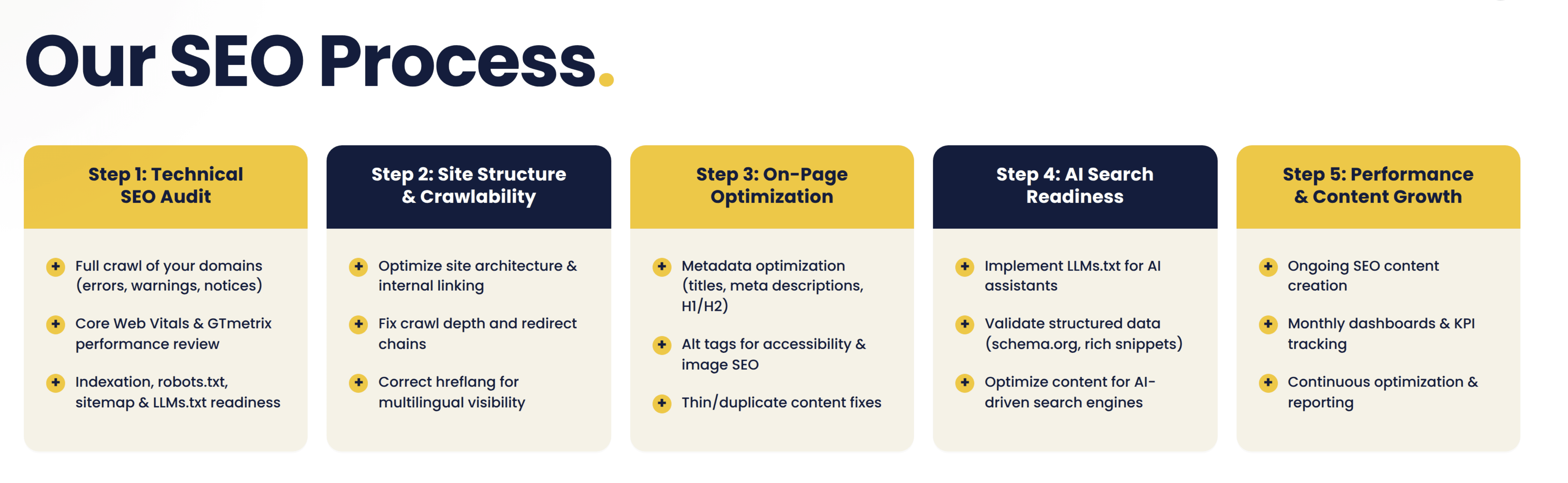
Phase 1: Audit and Foundation (Month 1-2)
Start with a comprehensive technical audit. Identify issues with site speed, mobile usability, indexing, and security. Fix these foundational issues first. At the same time, conduct thorough keyword research to understand what your target audience is searching for and where the biggest opportunities lie.
Phase 2: On-Page Optimisation (Month 2-3)
Optimise your existing pages: title tags, meta descriptions, headers, internal links, and content quality. If your existing content is thin or outdated, refresh it with better information, updated statistics, and more depth. Set up or fully optimise your Google Business Profile if you have a physical presence.
Phase 3: Content Strategy (Month 3-6)
Launch a consistent content plan. Publish at least two to four high-quality articles per month targeting your priority keywords and topics. Build topic clusters around your core services. Include unique insights, case studies, and original perspectives that set your content apart from generic articles.
Phase 4: Authority Building (Ongoing)
Begin an ethical link-building programme. Pursue digital PR, industry partnerships, and guest contributions. Actively manage your online reputation through reviews and brand mentions. Layer in GEO optimisation by structuring content for AI readability and building third-party citations.
Phase 5: Refine and Scale (Month 6+)
Analyse what is working and double down. Identify your top-performing pages and create more content on related topics. Monitor algorithm updates and adjust your strategy accordingly. Expand into new keyword territories and content formats as your authority grows.
9. Looking Ahead: The Future of SEO in Thailand
The future of SEO is evolving into something more holistic than it has ever been. Success in 2026 and beyond requires integration of editorial, technical, UX, PR, and product thinking. It is no longer just about ranking. It is about building a digital presence so strong that search engines, AI platforms, and consumers all trust your brand as a reliable source.
The rise of agentic AI is the next frontier. AI assistants will not just answer questions. They will take actions on behalf of users: comparing products, checking availability, and even completing purchases. For businesses, this means your data needs to be machine-readable and your online presence needs to be comprehensive, accurate, and consistent across every platform.
Businesses in Thailand that invest in strong brand foundations, quality content, and technical excellence today will be best positioned to thrive in this evolving landscape. SEO is not dying. It is growing up. And the businesses that grow with it will reap significant rewards.


Restons en contact.
Suivez Asia Media Studio pour des conseils en matière de design et des mises à jour sur Facebook, Instagram et LinkedIn.