


There is a particular kind of frustration that shows up about eighteen months into a digital programme. The campaigns are running. The reporting deck is full. Reach is fine, impressions are fine, the agency is hitting the agreed cost per click. And yet the business is not obviously better off than it was a year ago. Sales are flat, or growing only as fast as the media budget. Nobody in the market seems to know who the company is beyond the last promotion they ran.
The instinct at that point is to change the media plan. Move budget from Meta to TikTok. Test new audiences. Hire a different performance specialist. Sometimes that helps for a quarter. More often it does not, because the problem was never the targeting. The problem is that the company has been buying attention without owning anything for that attention to land on.
This article is about the gap between branding and digital marketing, and why treating them as separate line items is one of the more expensive habits in Asian marketing today. It is written from a particular vantage point. Asia Media Studio started in 2007 as a branding and creative studio and only added digital marketing in 2020, when the pandemic made the question unavoidable. That order matters, and part of what follows is an honest account of what we learned by arriving at digital marketing from the brand side rather than the other way around.
Two Industries That Grew Up Apart
For most of advertising history the brand and the media were handled by the same people. An agency developed the positioning, wrote the line, made the film and bought the space. The idea and its distribution were one conversation.
Digital pulled them apart for reasons that made sense at the time. Paid media became technical enough to need specialists: pixel implementation, audience structures, bid strategies, feed management, attribution modelling. A new category of agency grew up around those skills, while brand consultancies moved deeper into research, positioning frameworks and identity systems, further from the day-to-day of running a campaign.
The result is a market where a mid-sized company works with a brand agency once every five to seven years, for a defined project, and with a digital agency continuously, on a retainer measured entirely differently. The brand agency is judged on whether the client likes the work. The digital agency is judged on cost per acquisition. Nobody is judged on whether the two things are the same brand.
That split has consequences that are easy to miss because they accumulate slowly. The brand book gets written, presented, approved, and then sits in a shared drive. The digital team, under weekly pressure to produce volume, does what any sensible team does: it makes what performs. A discount graphic outperforms a positioning statement, so more discount graphics get made. A trend-jacking Reel gets ten times the engagement of the brand film, so the feed fills with trend-jacking Reels. Each decision is defensible. The cumulative effect, after two years, is a brand whose public face has almost nothing to do with the strategy that was so carefully approved.
The part that makes this hard to catch is that none of it shows up in a performance report. Cost per click does not degrade when a brand loses coherence. It degrades much later, indirectly, through worse conversion rates, faster creative fatigue, weaker pricing power, and a slow rise in what it costs to get a stranger's attention. By the time it appears in the numbers, it looks like a media problem.

What 2020 Actually Taught Us
We had been doing brand strategy, identity and creative work in Bangkok for thirteen years before we ran a single ad campaign. The pandemic changed that, not because we saw an opportunity, but because our clients needed something we could not provide.
In early 2020 hotels closed, retail stopped and B2B pipelines froze. Clients who had built presence through trade shows, print, showrooms and sales teams suddenly had one channel left. The requests were urgent and practical: get us selling online, get us visible, get us talking to customers who are all at home on their phones. Several already had digital agencies and were unhappy with what came back. What we heard repeatedly was some version of: the ads are running but they do not look like us, and the messages do not sound like anything we agreed.
That was when the case for building digital marketing in-house became obvious. Not because paid media is difficult to learn, but because the handover between brand and media was where the value was leaking. Every time a positioning document crossed from one company to another it lost fidelity. The digital team received a PDF and a logo file, made a reasonable interpretation, and produced something adjacent to the brand rather than an expression of it. Multiply that by twelve months of daily output and the drift is substantial.
So we built the capability internally: paid social and search, SEO and content, social media management, influencer and KOL programmes, e-commerce support, analytics. Same building, same account leads, same brand people in the room.
The lesson was not that we run ads better than a specialist performance shop. Plenty of specialists are excellent at the mechanics. The lesson was about where the compounding happens. When the person who wrote the positioning sits next to the person choosing the thumbnail, a hundred small decisions a week land on the right side of the line. Over a year, that is the difference between a brand that gets stronger while it spends and a brand that just spends.
There was a second lesson, and it was uncomfortable. Coming from the brand side, we had been guilty of the opposite failure: identity systems that were beautiful in a presentation and difficult to use in a feed. Palettes that lost contrast at thumbnail size. Logos with fine detail that disappeared in a nine-second video. Tone of voice guidelines written for brochures with nothing to say about a LINE chat. Running the media ourselves forced us to design brands that work where brands actually live now, which is inside somebody else's scrolling.
The Thai Market Makes This More Urgent, Not Less
If the argument so far sounds like general marketing theory, the Thai numbers give it a sharper edge.
Thailand has around 67.8 million internet users, roughly 94.7% of the population, and about 56.6 million active social media identities, close to 79% of the population. Reported ad reach runs to roughly 56 million on LINE, 51.5 million on Facebook, 47.2 million on YouTube and 20.6 million on Instagram, with TikTok reaching almost the entire adult population. Mobile connections stand at about 135% of the population.
That is close to saturation, which means the growth story for digital marketing in Thailand is over in one important sense: you can no longer win by being present somewhere your competitors are not. Everyone is on the same four or five platforms, buying from the same auctions, targeting substantially the same people. Our strategy guide to social media marketing in Thailand covers how those platforms differ in practice.
The ad market has stopped growing alongside it. Thai digital ad spend was about 32.2 billion baht in 2025, and the industry forecast for 2026 puts it at roughly 32.1 billion, a decline of 0.3%. That is the first negative year in fourteen years of tracking. On the 2026 forecast, Meta remains the largest platform at around 8.3 billion baht, with TikTok second at around 6.6 billion. Category momentum is uneven: skincare is forecast up around 19% in 2026 and vitamins and supplements grew 18% in 2025, while automotive is forecast down around 10% and retail fell about 6%.
Read that alongside the saturation numbers and the picture is clear. Thai marketers are, in aggregate, not able to spend their way to more audience, because there is no more audience to buy. In that environment, media efficiency is not a competitive advantage for long. Any technical edge in bidding or audience structure gets copied, automated, or absorbed by the platform within a couple of quarters, and much of what used to be an experienced buyer's craft is now a setting.
What does not get copied is who you are. Distinctiveness, the quality of being recognisably yourself, is the one input to a media auction a competitor cannot replicate by adjusting a bid. A brand that people recognise in half a second, trust on sight, and can describe to a friend gets more from the same impression than a brand that has to be explained every time.
When media was cheap and audiences were unsaturated, you could run a sloppy brand and buy your way past it. That option is closing.

What Brand Control Inside Digital Actually Means
"Integrated" is one of the most abused words in agency marketing, so it is worth being specific about what brand control means in practice. It is not a slogan. It shows up in a handful of concrete places inside a campaign, and any of them can be checked.
The content pillars come from the positioning, not from the platform. Most social calendars in Thailand are built from platform logic: what is trending, what format the algorithm is pushing this month, what competitors posted. A brand-controlled calendar starts from three or four pillars derived from the brand's positioning and proof points, then asks how each should be expressed in the format the platform rewards. The trend still gets used. It just carries something the brand actually needs to say.
The creative system is built for the feed, not adapted to it. A brand identity designed for digital answers questions a traditional brand book never asks. What does the logo do at 48 pixels? Which two colours carry recognition when the palette is reduced to a thumbnail? What is the brand's motion signature, the two or three seconds of movement that make a video identifiable before anyone reads a word? What does a subtitle look like? These are identity decisions, not production decisions, and they belong to the people who own the brand.
Paid creative is tested within brand boundaries, not outside them. Performance teams test relentlessly, which is correct. The question is what varies. If the test matrix varies hooks, offers, formats and audiences while holding the brand system constant, testing makes the brand sharper. If it varies the brand itself, testing quietly dissolves it. We have seen accounts where the best-performing ad set used a colour, typeface and tone that appeared nowhere else in the company. That ad worked in the narrow sense, and it made the brand weaker.
The landing experience matches the ad. Common and easy to fix. A campaign builds a specific expectation in three seconds of video, then delivers a page with different photography, a different tone and a different value proposition. The bounce is recorded as a landing page optimisation issue. It is a brand continuity issue.
Influencer and KOL briefs carry the brand, not just the message. Thailand's creator economy is unusually developed, and a meaningful share of a brand's total impressions arrive through someone else's content. If the brief lists product features and mandatory hashtags but gives the creator no sense of the brand's character, the creator will substitute their own. Multiply that across twenty creators and the brand has twenty personalities.
Customer conversation is treated as brand expression. This matters more in Thailand than in most markets, because LINE functions as national infrastructure rather than as one app among many. Banks, government services and a large share of businesses run direct customer communication through LINE Official Accounts, and for many Thai customers a one-to-one chat is the most substantial contact they will ever have with a brand. If the brand voice document has nothing to say about how the brand replies to a complaint at nine in the evening, the brand voice does not exist where it counts.
None of these six points requires a bigger budget. They require the brand and the media to be governed by the same people, or at minimum the same rules, enforced weekly rather than annually.

The 60/40 Question, and Why Thailand Gets It Wrong in Both Directions
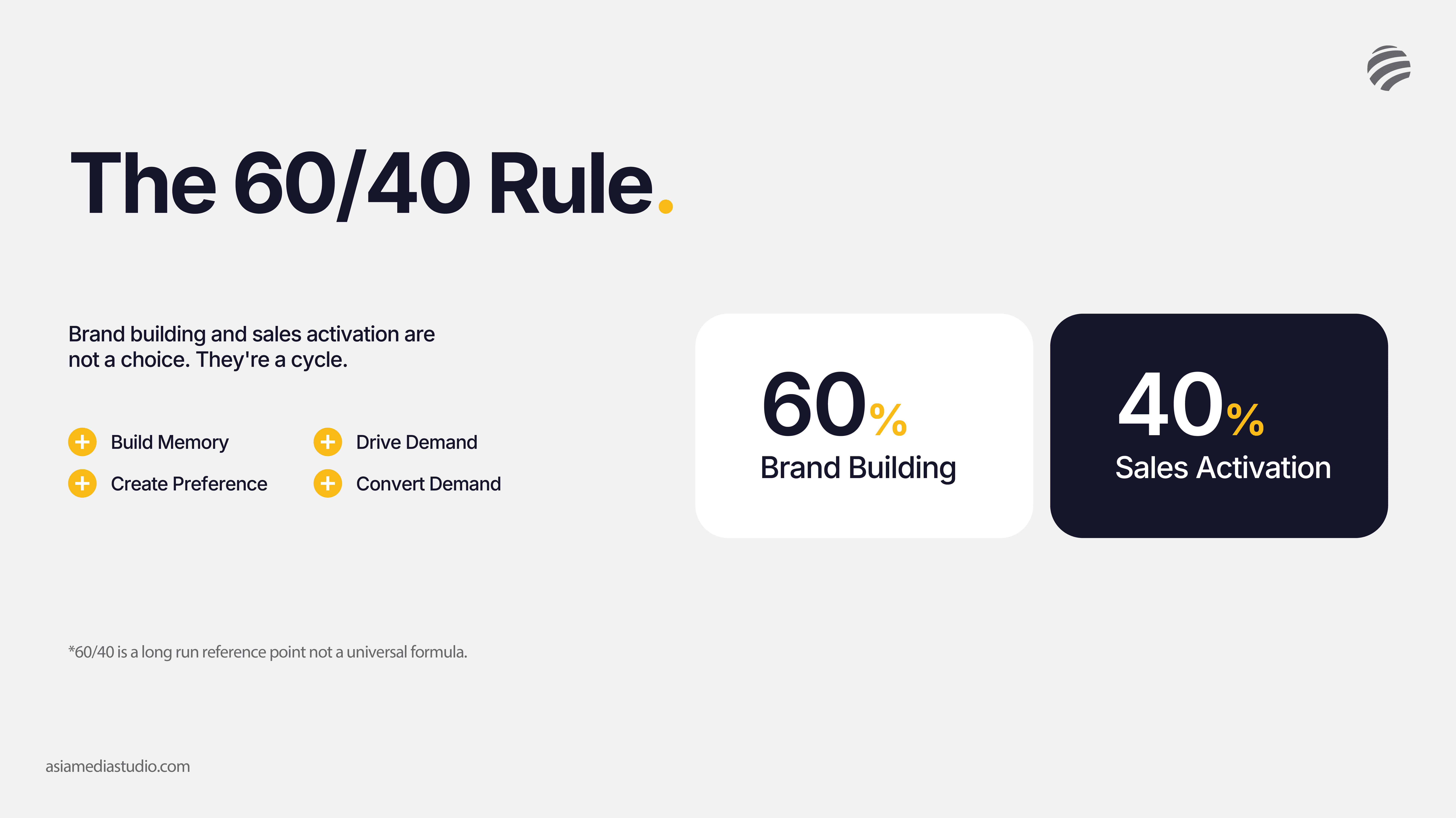
The effectiveness research from Les Binet and Peter Field, drawn from the IPA's databank of campaign case studies, points to roughly 60% of budget towards brand building and 40% towards sales activation as the long-run average optimum. The ratio varies by category and Binet himself has been clear it is not an iron rule. The underlying finding is more durable than the number: activation drives short-term response and decays quickly, brand building works slowly and compounds, and a plan weighted entirely towards either one underperforms a balanced plan.
None of this is new thinking, and we have made the wider case for it in why brand strategy is the foundation of business growth in Thailand and across Asia. In practice, the Thai market splits into two camps that get this wrong in opposite ways.
The first is the performance-only company. Usually a challenger brand, often e-commerce, often founder-led, with a dashboard culture and a healthy suspicion of anything that cannot be attributed. This company grows fast at first, because activation works, then hits a wall that looks like a media problem: cost per acquisition creeps up quarter after quarter, creative fatigues faster, discounts get deeper, and the business finds it is buying the same customers repeatedly rather than building a base. The wall is not the media. It is that nobody has a reason to prefer this brand at full price.
The second is the brand-only company. Usually established, often family-owned or corporate, with a real identity, a strong reputation among people who already know them, and a digital presence that is essentially decorative. This company is not building brand either, despite appearances, because a brand that reaches nobody new is a memory rather than an asset.
Both camps have the same diagnosis: the brand and the media are not talking to each other. In the first case the media runs without a brand. In the second the brand sits without media.
One clarification before the practical numbers. Binet and Field's 60/40 applies to the whole marketing budget, including everything outside digital. Digital budgets skew towards activation by design, because that is what the channel was built to do, so the digital line on its own will sit lower than 60% brand in most healthy plans. What matters is that the total lands somewhere sensible and that the digital half is not entirely activation.
As a starting point rather than a formula, a workable split for most mid-market brands in Thailand puts a third to a half of the digital budget into work that is broad, distinctive and not immediately attributable: brand films, always-on reach, creator content that builds character rather than pushing an offer, content and SEO that answers questions people ask long before they buy. The rest goes to activation: conversion campaigns, retargeting, high-intent search, promotional pushes tied to the cultural calendar. Considered purchases with long cycles, education, healthcare, property, B2B services, tilt further towards brand. Fast-moving e-commerce with genuine repeat purchase can justify more activation. What does not vary is that both need to exist and be planned together.
Five Failure Modes We See Repeatedly
Abstract arguments about integration are less useful than symptoms. These are the patterns that come up most often when a company asks us to look at why their digital marketing is not producing what they expected.
The feed that looks like three different companies. This is the most common symptom in social media marketing, and the easiest to check. Scroll a brand's Instagram grid or TikTok profile and count how many visual systems appear in the last thirty posts. Different typefaces, colour treatments, photographic styles, logo lockups. This usually happens because the content was produced by three suppliers over eighteen months, each doing competent work with no shared system. The cost is invisible in any single post and considerable in aggregate: the brand never accumulates recognition, so every post starts from zero.
The KOL who cannot describe the brand. A useful and slightly brutal test. Call three creators who have posted for the brand in the last six months and ask them, without warning, to describe it in one sentence. If the answers are all different, or all product-feature descriptions with no character in them, the brand is not travelling through the channel where most of its impressions happen. Fixable with a two-page creator brief covering character, tone, what the brand stands for and what it would never say. The same principles that make a good agency brief apply here.
The promotion that ate the brand. A discount campaign outperforms brand content, so the calendar tilts towards discounting. Six months later the audience has been trained to wait for the next promotion, full-price sales soften, and the brand's public identity is a rolling sequence of percentage-off graphics. Platform mechanics accelerate this in Thailand: double-digit sale dates and livestream commerce reward aggressive discounting, and a brand without a firm position on how it participates gets pulled in.
The strategy nobody reads. A brand strategy project completes, a handsome document is delivered, and it is never turned into anything a content producer can use on a Tuesday morning. The gap is a missing translation layer: the strategy says "warm, expert, unpretentious", and nobody has converted that into caption rules, example posts, a short list, a do-and-do-not list and a review checklist. Strategy that has not been translated into weekly production instructions has not been implemented, however good it is.
The measurement that only sees the last click. When reporting is entirely bottom-funnel, everything that builds the brand looks like waste, so it gets cut, and the numbers get worse slowly in a way the reporting cannot explain. This is how a company optimises itself into decline while every individual decision looks data-driven.
Starting From a Logo: Building the Brand Core
A significant share of the companies that come to us have a logo and very little else. Often it was produced quickly at company registration, or by a relative, or by a freelancer working from a one-line brief, and it has carried the entire weight of the brand ever since.
This is a normal place to start. Founders build products and revenue first, which is the correct order. The problem arrives at scaling, when the company needs to hire marketing people, appoint an agency, enter a new segment or raise money, and discovers there is nothing behind the logo for anyone to work from. The website says one thing, the sales deck another, the packaging a third.
What a logo does not give you is worth spelling out: a reason for a customer to choose you, an answer to what you refuse to do, a voice, a hierarchy of messages for different audiences, a system for how the brand behaves in formats the logo was never designed for, or an agreed definition of who you are for.
Building a brand core from there is not the same as a full rebrand. It combines brand strategy with the logo design and brand identity work that turns a mark into a system, and in many cases the logo itself stays, sometimes with technical refinement for digital use, while everything around it gets built. For a sense of what changes when this is done properly, our before and after rebranding examples show it more clearly than any description can.
The sequence we use:
Audit and orientation. Before proposing anything, we go and look. What does the company actually sell, to whom, at what price, against whom? What do existing customers say when asked why they chose it, which is very often different from what the company believes? Where is the competitive set crowded, visually and verbally? For international brands entering Thailand this stage carries extra weight, because assumptions imported from another market are the most expensive kind.
Positioning. What this brand is for, who it is for, what makes it a genuinely different choice rather than a slightly different-looking one, and what it is prepared to give up in order to be that. The last part is where most positioning work fails. A position that costs the company nothing to hold is a wish list.
Brand personality and values. Not a poster of adjectives, but a working description of character that a copywriter, a designer and a customer service agent can each act on. "Innovative, trusted, customer-focused" describes almost every company in Thailand and instructs nobody.
Verbal identity. Naming where relevant, a positioning line, message architecture for the audiences that matter, tone of voice with worked examples, and the vocabulary the brand uses and avoids. In Thailand this has to be built bilingually and culturally rather than translated afterwards. A line that works in English and reads awkwardly or comically in Thai has failed, and it is a mistake we see monthly.
Visual identity system. Logo refinement where needed, a colour system with digital contrast tested, typography including a Thai typeface chosen to sit properly with the Latin one, photographic direction, iconography, layout principles and a motion signature. Choosing a Thai typeface is not a cosmetic decision, and we have written separately about how to choose the right font for your brand in Thailand. The full set of components a system needs is covered in our overview of corporate identity and its 18 key elements.
Application and asset build. Where the system becomes usable: social templates by format, ad templates to each platform's specifications, presentation and document templates, website design direction, packaging, signage, email and the LINE Official Account presence. The test is not how it looks in the guideline document, it is whether a junior designer can produce a correct asset on a deadline without asking anyone.
Governance and handover. Guidelines that are actually read, which means short, visual, example-led and hosted where people work rather than buried in a drive. A review checklist. A named owner. Ideally a first quarter of production run alongside the people who built the system, because that is when ambiguities surface.
Done properly this takes six to twelve weeks for a mid-sized company, and our logo design process sets out the identity stage in more detail. A company spending three million baht a year on digital marketing against an incoherent brand is wasting a meaningful fraction of it on impressions that build no memory.

The Case That the Brand Work Pays for Itself
Brand investment is often argued for on faith, which is not a good look in a room full of people who report on cost per acquisition. There are more concrete mechanisms, and they are worth naming because they can be tracked.
Attention is cheaper for a recognisable brand. Platform auctions reward engagement, and creative that is immediately identifiable to people who have seen the brand before tends to earn better early signals, which affects delivery and cost. Distinctiveness is not only a marketing virtue here, it is an input to the price you pay for reach.
Conversion improves when the promise is coherent. The gap between what an ad implies and what the site delivers is where conversion rate goes to die. Fixing brand continuity across the journey often produces an improvement indistinguishable from a landing page optimisation win, at a fraction of the effort.
Creative fatigue slows down. Brands with a strong system refresh executions while keeping recognisable assets constant, so the audience keeps seeing something familiar in something new. Brands without a system have to change everything to feel fresh, which resets recognition each time and burns production budget faster.
Search demand grows. The most measurable of the lot, and the point where brand work and SEO stop being separate disciplines. Brand building shows up as branded search volume, and branded search converts at rates non-branded traffic rarely matches while costing far less to serve. A digital programme that is building brand should produce a visible upward trend in branded queries over twelve to eighteen months. If it does not, it is running activation only, whatever the plan says. Our complete guide to SEO in Thailand goes into how that demand gets captured.
Pricing power holds. The clearest commercial expression of brand strength is selling at full price without a promotion attached. Companies that discount continuously are paying a permanent tax for the brand equity they did not build. The same logic extends to the business itself: in a sale or a funding round, a company with a defined brand, owned assets and properly protected marks is a different proposition to one with a logo and an ad account.
What an Integrated Month Looks Like
The difference between an integrated programme and a split one is mostly visible in the calendar.
At the start of a quarter, the brand and media conversation happens once, together. The commercial objective is agreed, campaign moments are placed against Thailand's cultural calendar, which for most brands means at minimum Songkran, Chinese New Year, Loy Krathong and the mid-year and year-end platform sale dates, and the content pillars are set from the positioning. Budget is split explicitly between brand building and activation, both written into the same plan rather than negotiated separately.
Production then runs in batches rather than post by post, because batching is what makes consistency affordable. One shoot or production sprint yields the quarter's photography, video and template variations across all formats, built from a single direction. This is the most effective operational fix for the three-different-companies feed, and it usually costs less than piecemeal production.
Weekly, performance data changes what is produced next, but within the system rather than around it. When a test suggests going outside the system, that becomes a brand conversation rather than a media decision made in a spreadsheet, and sometimes the answer is yes, because systems should evolve. The point is that someone decides deliberately.
Monthly reporting covers both halves: cost per result, conversion rate, return on ad spend and pipeline alongside branded search volume, share of voice, direct and organic traffic, follower growth quality and comment sentiment. The two sets are read together, because either one alone tells a misleading story.
Quarterly, the system itself gets reviewed. What broke, what was missing, which format had no template, which message keeps being reinvented because it was never properly defined. Guidelines get updated. Almost everyone skips this step, which is why most identity systems degrade within two years.

For International Brands Entering Thailand
A specific version of this problem shows up with international brands arriving in Thailand, and the failure is remarkably consistent.
The global brand arrives with a complete identity system, a global tone of voice and campaign assets developed elsewhere. A local digital agency is appointed to run media and given assets to localise, which in practice means translating the copy and resizing the artwork. The campaign runs, underperforms, and the analysis focuses on media efficiency.
What was missing is the layer in between: the judgment about what this brand should mean to a Thai audience specifically, which global messages matter most here, which visual assets carry the intended meaning in this cultural context, what the voice sounds like in Thai rather than in translated English, and how the brand participates in a cultural calendar its headquarters has never heard of. That layer is brand work, and it has to happen before the media plan rather than after the campaign underperforms. We covered the cultural dimension at length in how cultural nuance shapes branding that works in Thailand, and it remains the most common gap we find. There is also a practical checklist in what yo ur brand needs to succeed in the Thai market.
The global identity usually does not need to change. What needs to exist is a Thai-market brand layer, developed locally, sitting between the global system and the daily media output. Companies that build it tend to find their media efficiency improves without changing anything about the media.

What This Means in Practice
A set of principles for anyone deciding how to structure branding and digital marketing.
Treat the brand as an operating system. It needs an owner, a review rhythm and a mechanism for updating it when reality changes.
Put the brand decision before the media decision, every quarter. A content calendar built from what is trending has the sequence backwards.
Insist that testing varies the message while the identity system stays fixed. When a test wants to break the system, escalate it.
Design the identity for the smallest and fastest format first. If it works in a nine-second vertical video and a 48-pixel avatar, it will work on a brochure. The reverse is not true.
Write the brand voice for conversation as well as broadcast. In Thailand the LINE reply, the comment response and complaint handling all belong in the brand voice document.
Brief creators on character as well as product. What they understand about the brand is what the market receives.
Measure both halves, or the brand half gets cut. Branded search volume, share of voice and direct traffic belong in the same monthly report as cost per acquisition.
Build the brand core before scaling media spend. A company about to increase its digital budget significantly, running on a logo and improvisation, will get more from spending part of that increase on the foundation first.
Keep the two functions under one accountability, whether that is one agency, one internal team, or two suppliers governed by a single set of rules and a single weekly review.
A Quick Self-Audit
A short set of questions worth answering honestly before the next planning cycle.
Can three different people in the company describe the brand's positioning in one sentence, and would those sentences broadly match?
Looking at the last thirty pieces of published content across all channels, would a stranger recognise them as coming from the same company without reading the account name?
Does next quarter's content calendar trace back to the brand's positioning, or to a list of trends and platform moments?
If a creator posted about the brand tomorrow with no supervision, would they get the character right, and is there a brief that would help them?
Is there a written answer to how the brand replies to an unhappy customer on LINE at nine in the evening?
Does the monthly report contain at least one metric that measures brand strength rather than campaign response, and has it moved in the right direction over the last year?
When a paid test produces a winner that sits outside the brand system, is there a process for deciding what to do, or does it just get scaled?
If the brand had to run a full-price campaign next month with no discount attached, is there a reason a customer would still choose it, and is that reason written down anywhere?
A company that answers yes to most of these has brand control. A company that answers no to most is buying attention on behalf of a brand that does not yet exist, which is an expensive way to build a business.
How AMS Approaches This
We are a branding agency that runs digital marketing, not a digital agency that also does logos, and the order is not an accident. Nineteen years of brand strategy and identity work in Bangkok, thirteen of them before we ran a single ad campaign, across hospitality, healthcare, education, professional services, retail and consumer goods, with long-running relationships including Baxter, Minor, Sofitel, Fairmont, Hilton, The Nai Harn, Sirru Fen Fushi, Tilleke & Gibbins, International School Bangkok, ReignWood Estate and EastConsult. Digital marketing came in 2020, for the reasons described above.
For clients who come to us with a brand and want digital marketing, the media plan is built from the brand rather than beside it. The people who own the positioning are in the room when the content calendar is set, the creative system is designed for the formats the campaign will actually run in, and the monthly report covers brand health alongside performance.
For clients who come to us with a logo and not much else, which is more common than people assume, we build the brand core first: audit, positioning, personality, verbal identity, visual system, application and a governance handover. Often the logo survives, refined for digital use, and what gets added is everything that makes it mean something. The digital programme then runs on top of it, which is a very different exercise from running a programme on top of a name and a colour.
Neither is complicated as an idea. It is mostly a question of who is accountable, and whether the brand gets a vote every week rather than every five years. Both halves are described in more detail on our branding and digital marketing service pages.
Four Projects Where This Played Out
Thompson Golf Management. An international golf consultancy managing more than 100 courses across 20 countries, rebuilt over a twelve-week engagement that covered brand identity, UX and website, SEO, digital marketing and social media in a single scope. This is the clearest example of what the article argues for: one team, one system, the positioning and the media plan decided in the same conversation rather than handed between suppliers.
Bangchak. Two years of ongoing creative support for one of Thailand's largest energy companies, spanning UI and UX, brand and corporate identity, packaging and social media. The part most relevant here is the social media template system built against the brand guidelines, which is the practical answer to the feed that looks like three different companies. Templates are where a brand system either becomes usable at production speed or quietly stops being followed.
Lightera. A global optical fibre and connectivity company building its presence in Southeast Asia, supported over 30 months with more than 250 pieces of content, a design system anchored on the brand's existing palette, content strategy and Meta campaign management for the Thai market. This is the Thai-market brand layer described above, sitting between a global identity and the daily output, with the media running on top of it rather than beside it.
Lia Coffee. A café chain with six campus locations, starting from close to nothing: a custom logo, a modern identity system, design guidelines and more than 25 branded assets, then rolled out across social and print on a flexible production model. The brand-core-first sequence, applied to a business that had the product and the locations before it had the brand.
Frequently Asked Questions
Should I do branding first or start digital marketing immediately?
If the business needs revenue now, start marketing now. The two are not sequential in the sense of one blocking the other. What matters is not spending heavily on media against an undefined brand for a long period. For most companies the practical approach is a lean activation programme for immediate demand while the brand core is built in parallel over six to twelve weeks, then scaling media once there is a system for it to express.
What does a brand core project involve and how long does it take?
Typically six to twelve weeks for a mid-sized company: audit, positioning, personality and verbal identity, visual system, application into the templates and assets the company actually uses, then guidelines and handover. The variable is usually the number of stakeholders and how quickly decisions get made rather than the production work itself.
We already have a logo. Do we really need brand strategy as well?
A logo is an identifier, not a strategy. It tells people which company they are looking at. It does not tell them why they should choose you, what you stand for, how you sound, or what you will not do. Companies operating on a logo alone function well until they scale, at which point every new hire, agency and channel produces its own interpretation and the brand fragments. If you are about to increase marketing spend, hire a marketing team or enter a new market, that is usually where the absence starts costing real money.
Can we keep our existing logo and still build a full brand?
In most cases yes. A brand core project does not require redesigning the logo. What frequently changes is technical: simplified variants for small sizes, a clear-space rule, adjustments for digital contrast, an avatar version. Positioning, voice, colour system, typography, photography direction and templates get built around it.
How is an integrated agency different from hiring a brand consultancy and a performance agency separately?
It can work either way, and some companies run the split model well. The difference is where fidelity is lost. With two suppliers, the brand crosses a boundary as a document and gets reinterpreted daily by people who were not in the room when it was decided. If you do run the split model, insist on a single weekly review where both parties are present, and make brand health metrics part of the media agency's reporting.
How much of a digital budget should go to brand building rather than performance?
Binet and Field point to roughly 60% brand and 40% activation as the long-run average optimum, though that covers the whole marketing budget rather than the digital line alone, and neither author treats it as a rule. Because digital skews to activation by design, a third to a half of the digital budget going to broad, distinctive, not-immediately-attributable work is a reasonable starting point for most mid-market brands in Thailand, tilting further towards brand for considered purchases with long decision cycles.
How do you measure whether brand work in digital is actually doing anything?
The most accessible indicator is branded search volume, which should trend upward over twelve to eighteen months if brand building is genuinely happening. Beyond that: share of voice against a defined competitive set, direct and organic traffic, the proportion of sales made at full price rather than on promotion, engagement quality, comment and review sentiment, and where budget allows a light annual tracker on unaided awareness and key associations.
Does brand consistency mean every post has to look the same?
No, and rigid sameness is its own failure mode, particularly on platforms that reward native, informal content. The distinction is between consistency of system and uniformity of execution. The recognisable assets, colour, typography, logo behaviour, motion signature and tone, stay constant. Format, subject, energy and style can vary a great deal within that.
Is this relevant for B2B companies, or mainly consumer brands?
It applies at least as much to B2B, and often more, because B2B decisions involve multiple people over long periods and a great deal of perceived risk. In a long buying cycle most of your future customers are not in the market today, which means much of marketing's job is being remembered favourably by people who will not act for months. B2B companies running only high-intent activation are competing for the small share of the market currently buying, at the highest possible cost, against everyone else doing the same.
See the Work
Every project described above, and around a hundred more across branding, website, digital marketing and communication design, is in our portfolio.
Sources referenced
DataReportal, Digital 2026: Thailand (internet, social media and platform user figures)
DAAT / Thailand Digital Advertising Spend 2025 to 2026 (ad spend by platform and industry)
Les Binet and Peter Field, The Long and the Short of It, IPA Databank (brand building versus sales activation)


Let’s keep in touch.
Follow Asia Media Studio for design insights and updates on Facebook, Instagram, and LinkedIn.